
 ?
?
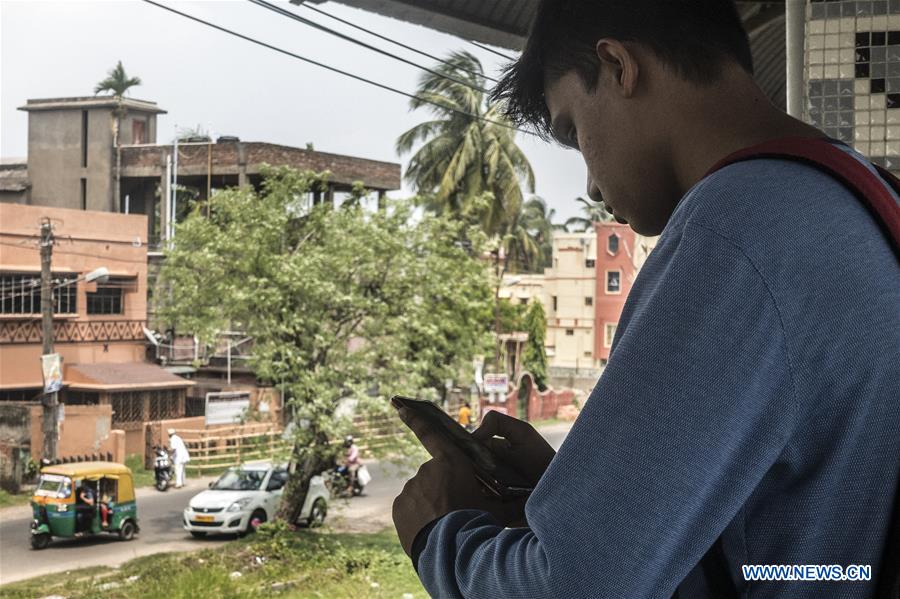
A man checks mobile phone in Kolkata, India on May 30, 2019. Over years, fake news have emerged as a big challenge in India both for the government and the civil society, even as it led to violence and tension in the society, at times even killings. TO GO WITH Spotlight: Fake News in social media big challenge in India (Xinhua/Tumpa Mondal)
by Pankaj Yadav, Apra Vaidya
NEW DELHI, May 30 (Xinhua) -- Over years, fake news have emerged as a big challenge in India both for the government and the civil society, even as it led to violence and tension in the society, at times even killings.
WhatsApp, Facebook, Instagram, Twitter are some of the major social media platforms followed by an estimated over 200 million users on a daily basis in the country.
Following concerns raised from among the civil society and social groups, the government has indeed taken a stern note and opted for a few measures to curb the ill-effects of spread of fake news.
People have been sensitised and made aware about the misuse of social media through public advertisements, and it has fortunately resulted in creating an impact in the recent months.
Now, people have begun raising doubts about sensational news being spread on social media, but it still remains a big challenge before the government and society as a whole.
Besides the U.S., India is the only country which has its own country head for WhatsApp. The setting up of "WhatsApp India" in November 2018 partially fulfilled the demand of the Indian government to curb the spread of fake news on the social media chat-app. The move assumed significance in the wake of more than a dozen killings across India in 2018 in incidents of mob lynching allegedly fuelled by rumours circulated on WhatsApp.
A couple of years ago, a video was allegedly spread by some miscreants on WhatsApp and other social media in Muzaffarnagar in northern state of Uttar Pradesh which sparked off intense communal violence leading to killings of many belongings to different communities.
As in February 2018 India had over 200 million monthly active users (MAUs), according to Facebook CEO Mark Zuckerberg.
Serious efforts have been made by both the Union government and state governments in educating the people how to check the spread of fake news, or verify it before forwarding to their known ones.
Spread of fake news has been a grave problem in India, in terms of inciting public unrest leading to social tension in the events of even a small incident involving two or more communities. Instances have taken place where a minor argument led to major clashes, thanks to the news made "viral" among the WhatsApp users.
A New Delhi-based communication professional said that Whatsapp was a powerful communication tool used by organizations to instantly disseminate information to multiple people in one go. However, unfortunately, Whatsapp and other social media have been used to create fake news and spread hatred, leading to even lynching in many states, he added.
Citing an example, she said, "Recently there was a photo that went viral on WhtasApp and social media about cattle dying in western state of Rajasthan in large numbers. That photo apparently was an old one taken in Kenya. Several people in my family and friend circle were discussing it at a gathering as disturbing news when I had to tell them that it was fake."
Editor of "Times Fact Check" Vivek Surendran told Xinhua that social media platforms like Facebook and Twitter were exploited by fake-news peddlers like never before in India. Old images and videos are spread with false claims, images and videos are digitally manipulated and shared with false claims. Graphic cards with random statements are shared widely without any verification, fake quotes are attributed to famous people, and the platforms can only do little to curb this misuse, he added.
Surendran further stated that platforms like Facebook are partnering with fact checkers and trying to give readers a link to a fact-checked story along with the posts spreading misinformation. "Combating fake news is tough for WhatsApp as a company because it ensures end-to-end encryption to its users. They cannot see what people are texting each other," he added.
At the insistence of the country's government, WhatsApp had in January 2018 restricted the forwarding limit to just five users. Globally, the limit is 20 chat. In India, it is five chats because India has this huge problem of misinformation spreading through WhatsApp.
Then in April this year, in another measure to curb its misuse WhatsApp introduced a new feature in a bid to check the spread of fake news in India. With the new feature named "Checkpoint Tipline" people can check the authenticity of information received.
This tipline will also help create a database of rumours to study misinformation during elections for Checkpoint -- a research project commissioned and technically assisted by WhatsApp, said an official statement issued by the social media giant.
To use it, people can submit misinformation or rumours they receive to a particular number of the Checkpoint Tipline WhatsApp. Once such message is sent, the verification center will seek to respond and inform the user if the claim made in the message shared is verified or not.
Government takes a special care in restricting the use of social media platforms in sensitive areas, like India-controlled Kashmir which regularly witnesses violence between the security personnel and the local youths. The aim is to prevent spread of fake news by miscreants that could lead to a serious security situation.
Speaking on condition of anonymity, a senior security personnel posted in Kashmir told Xinhua that social media platforms and Internet is generally restricted in this part of the country, as it is prone to violent incidents and overall security situation remains tense.
In the run-up to the just-concluded General Elections, a parliamentary panel met top Facebook officials and directed them to check misuse by a few trouble mongers who posted comments or statements targeting one particular political party.