



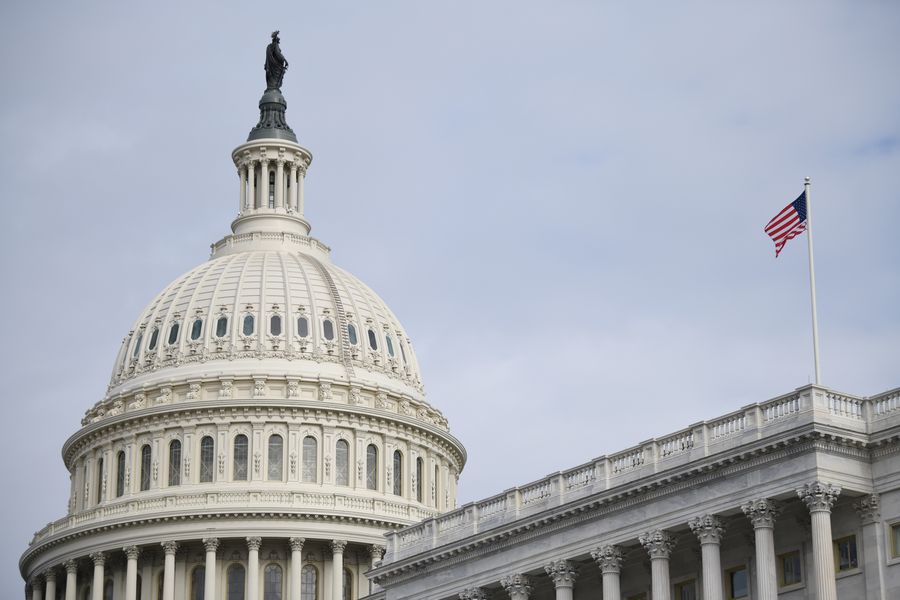
Photo taken on Dec. 4, 2019 shows the Capitol Hill in Washington D.C., the United States. (Xinhua/Liu Jie)
The drawn-out partisan wrangle throughout 2019 now drives the United States into the deep water of the 2020 election year, with two major upcoming events -- the Senate impeachment trial and the highly competitive Democratic primary.
by Xinhua writer Xu Jianmei
WASHINGTON, Dec. 26 (Xinhua) -- The year 2019, which kicked off in Washington D.C. with the longest-ever U.S. government shutdown and the inauguration of a Congress with more partisan split, is drawing to a close with Donald Trump becoming only the third president to be impeached in U.S. history as its final, discordant note.
The drawn-out and stepped-up partisan wrangle now drives America into the deep water of the 2020 election year, almost certain to produce more acrimony, division, and chaos.
At the center, two major events will usher in and help shape the country's bumpy election year: the impeachment trial in the Senate in January that Trump is widely expected to stand, and the highly competitive Democratic primary set to embark in early February.
TRUMP IMPEACHMENT
"I want an immediate trial!" Trump tweeted on Dec. 20.
The president's remark came two days after the Democrat-led House passed two articles of impeachment accusing him of abusing power and obstructing Congress, capping months of closed-door inquiries and public hearings in the lower chamber.
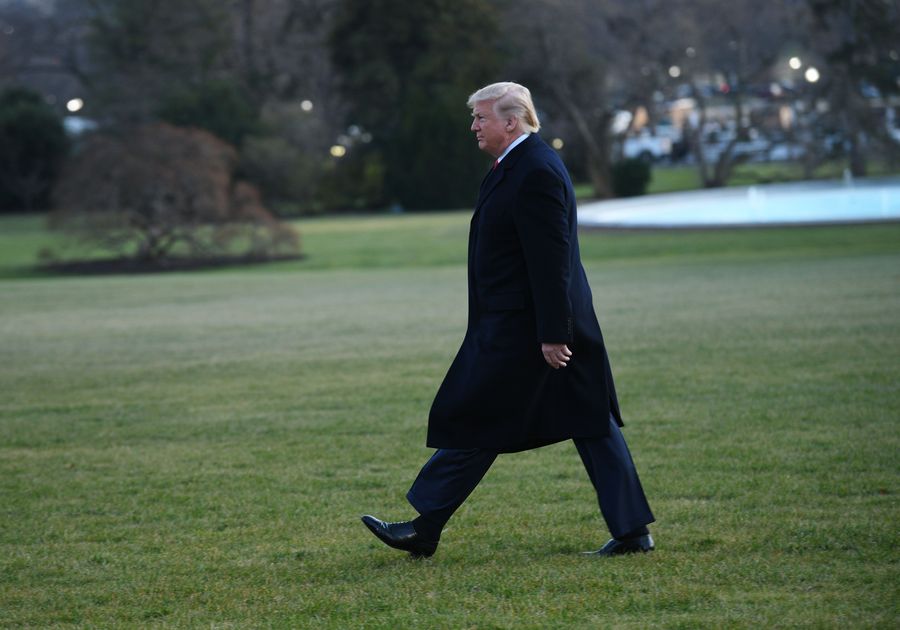
U.S. President Donald Trump leaves the White House in Washington D.C. Dec. 18, 2019. (Xinhua/Liu Jie)
However, Mitch McConnell and Chuck Schumer, top Republican and Democrat in the Republican-controlled Senate, have yet to agree on the rules governing the upcoming trial while House Speaker Nancy Pelosi still won't say if or when she plans to send the Senate impeachment papers.
"The House cannot choose our impeachment managers until we know what sort of trial the Senate will conduct," Pelosi defended her decision in a tweet on Monday.
"We're at an impasse," McConnell said in response.
Along partisan lines, Americans' views on impeachment are neatly split. An NBC News/Wall Street Journal poll released on the impeachment day found 48 percent of registered U.S. voters believe Trump should be impeached and removed from office, while an equal 48 percent say they disagree.
Moreover, both Democrats and Republicans show no willingness to move closer to each other on the impeachment. The poll showed some 90 percent of Republicans oppose impeaching Trump and removing him from office, while 83 percent of Democrats favor it. Among independents, 50 percent support impeachment and removal, while 44 percent oppose it.
"Views on Donald Trump's impeachment remain locked in place, with most Americans having made up their mind both on Trump and the impeachment investigation a long time ago," said Democratic pollster Jeff Horwitt of Hart Research.
The Democratic Party has won the first phase of impeachment battle in the lower chamber, but failed to make the case transcend the turning-white-hot partisan struggle, many local analysts observe.
Senate Republicans may follow suit by acquitting Trump in a quick wrap-up of the trial as McConnell has suggested, with little hope and efforts to sway opposite views.
"This is a political process. There's not anything judicial about it," the Senate majority leader said, calling himself "not an impartial juror."
The impeachment fight may further exacerbate polarization in the United States, leaving Republicans, Democrats and everyone in between feeling even more suspicious of one another, Emma Green with The Atlantic wrote.
However, polarization doesn't rule Washington every day. In the wake of the impeachment, the Capitol Hill passed a defense policy bill raising the annual U.S. defense spending by about 20 billion U.S. dollars while calling for sanctions against Russia and Turkey, an updated trade deal called the USMCA between the United States and its two largest trading partners, Canada and Mexico, as well as a 1.4-trillion-dollar spending package that will fund the federal government through the end of the 2020 fiscal year. All are considered as victories for both Trump and the Democrats.
"Both parties will be under pressure from voters to show they are capable of functioning and conducting some of the nation's business, despite impeachment," Clay Ramsay, a researcher at the University of Maryland, told Xinhua, adding "The U.S. public ... wants key domestic issues attended to however impeachment comes out."
DEMOCRATIC PRIMARY
No matter how the Senate trial will unfold next year, the chance for Trump to be convicted is quite small, if not "zero" as McConnell has asserted. Republicans show no sign of abandoning the president.
It won't be as easy to predict the outcome of the 2020 Democratic primary, which is likely to overlap a delayed impeachment trial when kicking off in early February amid high competitiveness between progressives and moderates. A recent poll found 57 percent of the Democrats might change their mind before the primaries and caucuses next year.
Based on most polls throughout 2019, former vice president Joe Biden, a moderate, keeps himself as a fragile front-runner on the sprawling field of Democratic challengers, followed by senators Bernie Sanders and Elizabeth Warren who are splitting the progressive vote.
To the surprise of many people, tech entrepreneur Andrew Yang has slightly overtaken Pete Buttigieg, mayor of South Bend in Indiana, in the 2020 Democratic primary net favorability rankings, according to a Morning Consult poll published on Tuesday. Former New York City mayor Michael Bloomberg, Minnesota Senator Amy Klobuchar, New Jersey Senator Cory Booker, activist Tom Steyer and House lawmaker Tulsi Gabbard from Hawaii are also fighting hard in hopes of becoming the party's banner-holder in the 2020 elections.
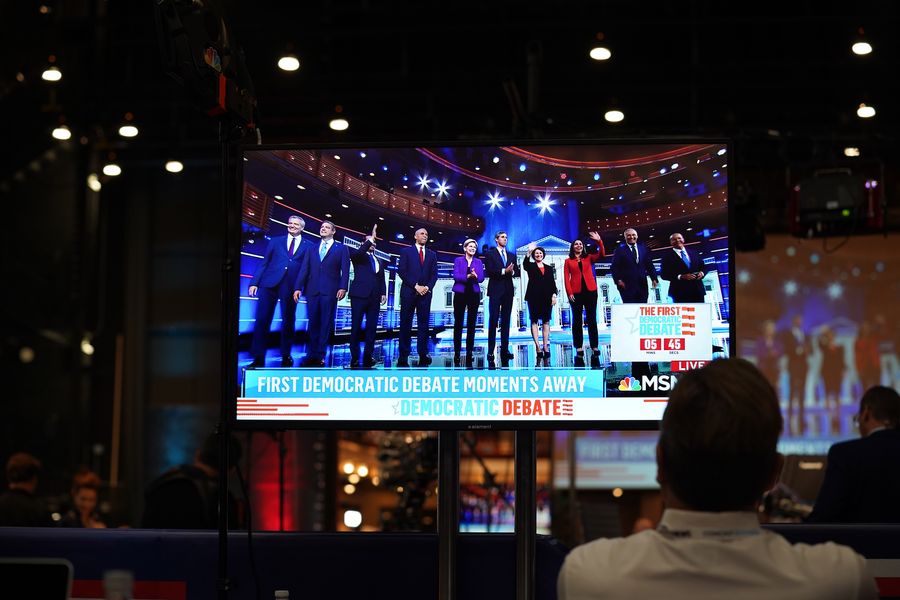
Ten Democratic contenders for the 2020 U.S. presidency take the stage at the party's first primary debate in Miami, Florida, the United States, June 26, 2019. (Xinhua)
However, beyond topics over Trump, the candidates disagree a lot, as six primary debates held by the party's national committee this year have shown. The issues they argue range from Medicare for All, free college, gun control, wealth tax to climate change. Progressive agenda has garnered much more support among Democratic voters than before.
This raises great suspense: Who will win the party's 2020 presidential candidacy, a progressive, a moderate, or someone in between?
"Democratic Party voters are split," said Thomas Edsall with Columbia University, citing a CBS survey breaking Democratic voters into three roughly equal groups: the most progressive wing, the middle group pressing bread-and-butter concerns like jobs, taxes and moderate health care reform, and those Democratic primary voters who describe themselves as moderate to conservative.
"The Democratic Party is actually three parties. They have different constituents and prefer different policies. Satisfying them all will not be easy," said Edsall on The Washington Post.
As a whole, the Democratic Party, which holds a rich racial diversity, has been moving leftward while the Republican Party moving rightward for years but more obviously during the Trump era, making the political polarization in the country worse, many local analysts observe.
The sharp division between Democrats and Republicans seems to work in Trump's favor. Brookings Institution Senior Fellow Darrell West told Xinhua that Trump's base has worried "about the left wing taking over, and see Trump as working hard to stop the left. He has very strong support from his base and this will continue through the 2020 election."
"This is the most polarized time in America that I have ever seen ... Because the country is so polarized, people don't vote according to what is right or what is wrong. They vote for parties," Mable Pryor, a middle-aged woman living in Montgomery, southern U.S. state Alabama, told Xinhua in an interview.
Partisanship continues to be the dividing line in the American public's political attitudes, far surpassing differences by age, race and ethnicity, gender, educational attainment, religious affiliation or other factors, according to a Pew Research Center report issued on Dec. 17.
In the 2020s, two divisive trends, shifting demographics and media polarization, will continue to shape, divide and challenge America, Myra Adams, a media producer and writer, has projected. ■
