



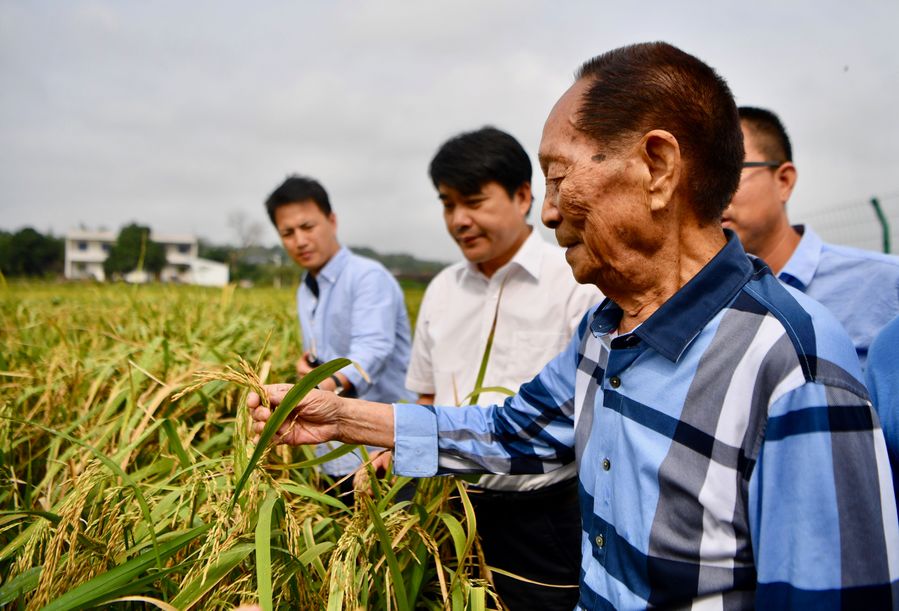
Yuan Longping, known as China's "Father of Hybrid Rice," inspects the new breed in the fields in Hekou Township in Xiangtan City, central China's Hunan Province, Sept. 29, 2017. (Xinhua/Xue Yuge)
Yuan Longping, father of hybrid rice, has helped China work a great wonder -- feeding nearly one-fifth of the world's population with less than 9 percent of the world's total land. While food shortages have long been consigned to China's past, the famine fighter has a much bigger ambition -- to save the world from starvation.
CHANGSHA, Sept. 26 (Xinhua) -- Yuan Longping, a globally renowned agronomist known for developing the first hybrid rice strains, just celebrated his 90th birthday in accordance with the traditional Chinese age counting system.
Yuan, born in September 1930, has helped China work a great wonder -- feeding nearly one-fifth of the world's population with less than 9 percent of the world's total land.
Getting enough to eat, however, used to be a serious problem in China. "I saw heartbreaking scenes of people starving to death on the road before 1949," recalled Yuan.
It was that year when Yuan applied for Southwest Agricultural College and began his special connection with rice -- a staple food of the Chinese people that would become the focus of his lifelong research career.
A discovery of a peculiar wild rice species by Yuan in the southern island of Hainan in 1970 became the prelude of China's decades of hybrid rice research. Three years later, he cultivated the world's first high-yielding hybrid rice strain with three lines, namely, the male sterile, maintainer and restorer.
Hybrid rice has since been grown across the country and farmers reaped incredible output after switching to Yuan's hybrid varieties.
Hybrid rice recorded an annual yield about 20 percent higher than that of conventional rice strains-- meaning it could feed an extra 70 million people a year. Now its accumulated planting area in China has exceeded 16 million hectares, with the total grain output 658 billion kg in 2018, a nearly fivefold increase from that of 1949.
"China has a large population but little arable land, the only way for us to guarantee our national food security is to increase crop yield," he said.
In 1986, Yuan brought up the hybrid rice breeding strategy -- from the three-line hybrid rice strain to a two-line, and later on to a one-line variety. The two-line technique means that the hybrid rice seeds are cultivated with the male sterile and restorer lines only, which will call for less complicated techniques, save labor and cut cost. Compared with its three-line predecessor, the two-line hybrid rice strain has higher yields and makes use of manpower and material resources more efficient, according to rice experts.
In 1995, local farmers planted 20,000 hectares of two-line hybrid rice in 55 counties on a trial base. The per hectare output reached 8,250 kg, 1,125 kg more than that of the three-line strain. The success established China's leading position in the global field of hybrid rice research.
In 1996, the Ministry of Agriculture formally established a super rice breeding program. Four years later, the first phase of the 10.5 tonnes per hectare target was achieved. The record was shattered three more times with jumps to 12 tonnes in 2004, 13.5 tonnes in 2011 and 15 tonnes in 2014.
Now the target of 18 tonnes per hectare is about to be achieved, according to Yuan.
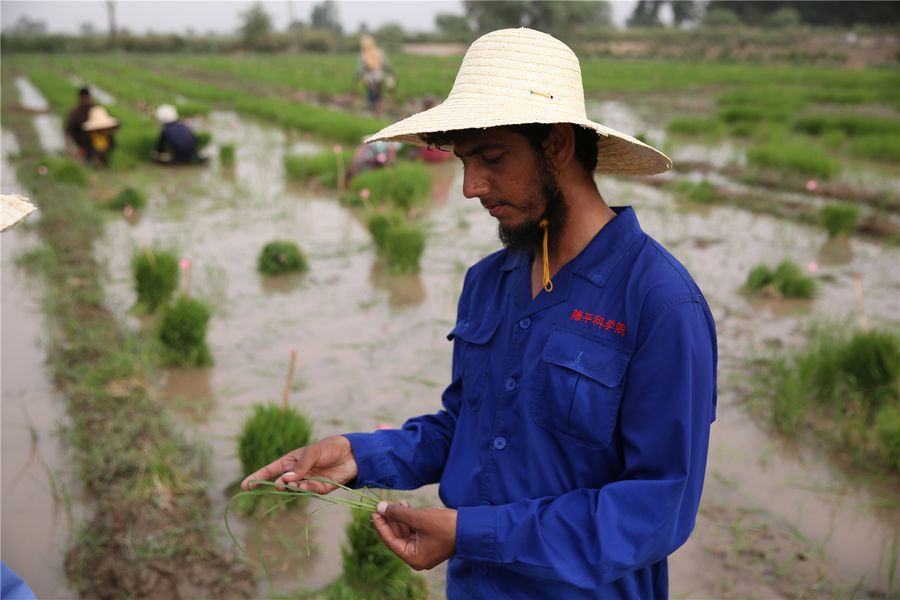
Wasim Waheed, research manager at a rice farmhouse, works at a rice field in Lahore of Punjab province in Pakistan, on July 10, 2019. A project was started here in 2014 and has been carried out by Guard Agriculture Research and Services in collaboration with Chinese Yuan Longping High Tech Agriculture Company. (Xinhua/Jiang Chao)
FROM CHINA TO THE WORLD
While food shortages have long been consigned to China's past, Yuan, the famine fighter, has a much bigger ambition -- to save the world from starvation.
Since the 1980s, Yuan's team has offered training courses in dozens of countries in Africa, the Americas and Asia -- providing a robust food source in areas with a high risk of famine.
With assistance from Yuan's team, a hybrid crop variety produced a harvest of 10.8 tonnes per hectare in Madagascar this year, far exceeding the yield of local rice. And the average yield of the hybrid rice planted in Kenya is four to five times greater than conventional varieties.
Globally, more than 820 million people were hungry in 2018, according to a UN report. And if hybrid rice is planted in half of the world's 147 million hectares of paddy fields, the additional yield alone can feed another 500 million people, said Yuan.
Yuan's team has continued to make new breakthroughs. Yuan's team was invited to make a trial plantation of the saline-alkaline tolerant rice in experimental fields in Dubai in January 2018, achieving huge success. China's export of saline-alkaline tolerant rice and the technique has been eyed as a way to combat the world's food insecurity.
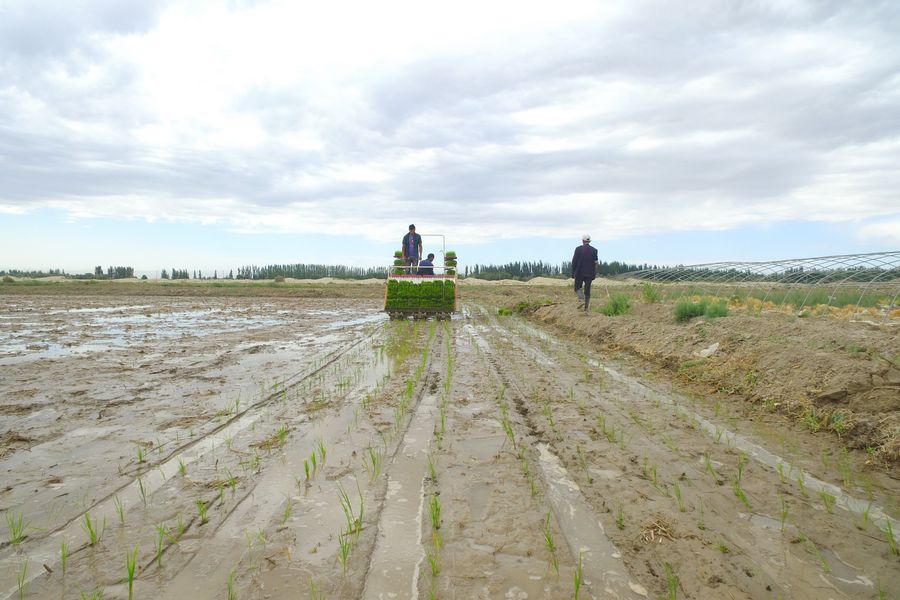
The saline soil rice R&D team of Yuan Longping work in a test field in Baiyiawati of Yopurga County, northwest China's Xinjiang Uygur Autonomous Region, June 3, 2019. The saline soil rice R&D team of Yuan Longping, the prestigious pioneer of hybrid rice, is expanding its planting scale on the western margin of the Taklimakan desert in Xinjiang Uygur Autonomous Region. (Xinhua/Ren Liying)
FROM HAVING ENOUGH TO EAT TO EATING WELL
Now the focus of Yuan's hybrid rice project has changed from increasing output to green and sustainable development. In September 2017, a strain of low-cadmium indica rice developed by Yuan's team and the Hunan provincial academy of agricultural sciences was able to reduce the average amount of cadmium in rice by more than 90 percent in areas suffering from heavy metal pollution.
"This is a huge breakthrough, and the technology is simple and inexpensive to apply," said Yuan. He is currently working on the third generation of hybrid rice, and striving to gradually replace the three-line and two-line hybrid rice in the next few years.
"Our country has entered a decisive period to complete building of a moderately prosperous society in all respects since the 19th National Congress of the Communist Party of China. To me, that means we are moving from 'having enough to eat' to 'eating well,'" he said.
"I am now in my 90s and hope that I can live to be 100 years old," he said. "I'm confident in the future of my country, and I want to make more contributions to its prosperity." ■
