





Photo taken on March 13, 2018 shows the headquarters of the People's Bank of China in Beijing, capital of China. (Xinhua/Cai Yang)
The recent weakening of the Chinese currency beyond 7 yuan per U.S. dollar is caused by factors including Washington's unilateral and protectionist measures, as well as the expectation of additional tariffs on Chinese goods for U.S. markets.
WASHINGTON, Aug. 6 (Xinhua) -- Ignoring market signals and economic common sense, the U.S. Treasury Department on Monday designated China as a currency manipulator.
After Washington announced plans to impose an additional 10 percent tariff on 300 billion U.S. dollars worth of Chinese goods starting Sept. 1, global financial markets were rattled, stirring turbulence in the foreign exchange markets.
The recent weakening of the Chinese currency beyond 7 yuan per U.S. dollar is caused by factors including Washington's unilateral and protectionist measures, as well as the expectation of additional tariffs on Chinese goods for U.S. markets.
Only a little over two months ago, the U.S. administration concluded that no major trading partner of the United States met the standard of currency manipulation last year.
Monday's abrupt shift in stance came ahead of the U.S. Treasury's update of its semi-annual report on international exchange rate policies, which is expected in the fall, and many believe that Washington's maneuver against China is another attempt to pressure China into submission by trade hawks in Washington.
So far, China's central bank, the People's Bank of China (PBOC), has reiterated that it is confident in its capability to keep the yuan's exchange rate basically stable.

A resident displays a 100-yuan banknote in Beijing, capital of China, Nov. 12, 2015. (Xinhua/Luo Xiaoguang)
Instead of going out of its way to support the value of the yuan above the symbolic seven-to-one threshold, the PBOC allows the yuan's exchange rate to fluctuate in response to market forces, demonstrating its steadfastness to deepen exchange rate reform and also its confidence in the yuan's long-term stability.
Despite weakening against the U.S. dollar, the yuan remains basically stable and strong against a basket of currencies, with the China Foreign Exchange Trade System yuan exchange rate composite index up 0.3 percent since the start of this year.
Moreover, the yuan's recent depreciation against the U.S. dollar was much smaller than those of the Korean won, the Argentine peso and the Turkish lira, making it a relatively stable currency among the emerging markets, and even stronger than reserve currencies such as the euro and the pound.
Viewed from a long-term perspective, the yuan has strengthened 20 percent against the U.S. dollar over the past two decades, the strongest among major currencies in the world, according to calculation by the Bank for International Settlements, an international financial institution headquartered in Basel, Switzerland.
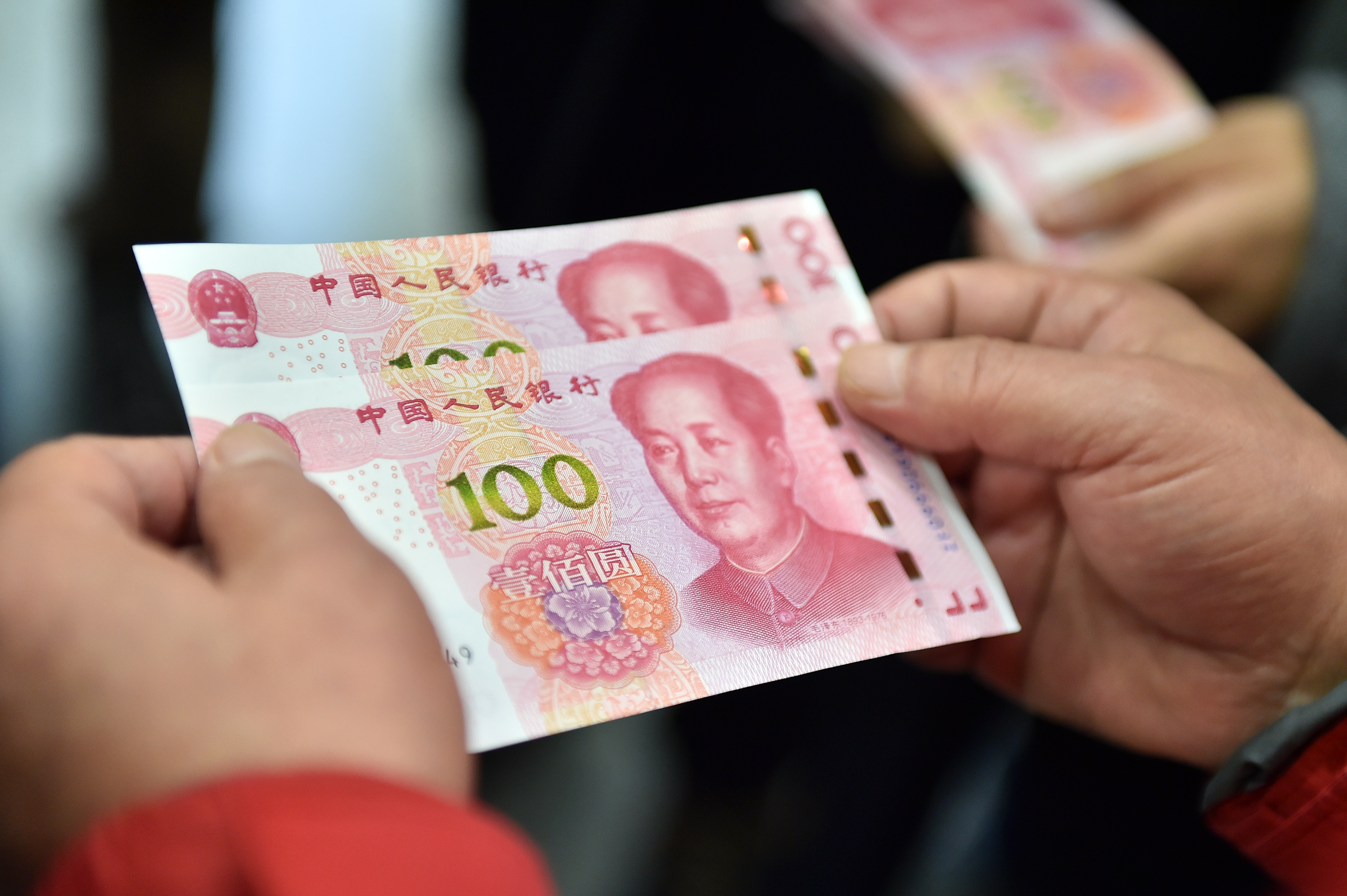
A resident holds two 100-yuan banknotes withdrawn from a bank in Beijing, capital of China. (Xinhua/Li Xin)
Looking forward, the yuan's exchange rate is buoyed by China's sound fundamentals, strong economic resilience, stable fiscal position, controllable financial risks, balanced cross-border capital movement and sufficient foreign exchange reserves, as stated by the PBOC, which is capable of cracking down on short-term speculation and stabilizing future market expectations.
China will remain committed to its promises on exchange rates made at all Group of 20 summits and abide by a market-determined exchange rate system, said PBOC Governor Yi Gang, who added that the country, refusing competitive devaluation, will not resort to exchange rates in handling external uncertainties such as trade disputes.
Labeling China a currency manipulator for political purposes is as reckless as it is irresponsible. It would further intensify the already high-flying U.S.-China trade tensions and inject new uncertainties into the global financial markets.
As the world's largest economy and the country which issues the major reserve currency, the United States should assume the responsibility of safeguarding the international financial and monetary system, and sustain the hard-won recovering momentum to prevent more global financial turbulence and economic downturns.
