BEIJING, July 19 (Xinhua) -- After helping scientists complete many significant experiments such as growing rice and vegetables in space, observing the strongest explosions in the universe and setting up the most precise clock in space, China's first space lab Tiangong-2 ended its mission and reentered the atmosphere under control Friday night (Beijing Time).
With deep attachment, Chinese scientists recalled the experience of participating in the design and implementation of the space experiments on Tiangong-2, and also looked forward to more frontier research on China's future space station.
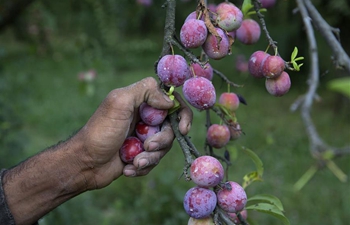
Zheng Huiqiong, a researcher at the Institute of Plant Physiology and Ecology of the Chinese Academy of Sciences (CAS), still remembered how she nervously waited for astronauts in November 2016 to bring back a small box containing the Arabidopsis thaliana, a kind of vegetable, which had grown on Tiangong-2 for about 50 days.
As the lead scientist of the experiment, she was the first one to see the plant with a little blossom.
"That was an unparalleled exciting moment," Zheng said.
Zheng's team put seeds of Arabidopsis thaliana and rice in the space lab to allow them to complete the growth process from seeds to producing seeds in space, the first such experiment carried out by Chinese scientists.
From the small box brought back by astronauts, the team harvested nine seeds, which have generated the fourth generation on Earth.
"The Tiangong-2 mission was our first opportunity to carry out a long-term plant experiment in space. This experiment is significant because growing grains and vegetable will be a necessity if humans want to leave the earth and have long-term survival and travel in space," Zheng said.
Many interesting and important discoveries have been made in the experiments of Tiangong-2.
"We found that plants grow slower in space than on Earth and blossom later. However, they live longer in space than on Earth. The lifespan of Arabidopsis thaliana in space was about twice as long as on Earth. We believe that the genes related to aging change in space," Zheng said.
"If we find the method to regulate the growth of plants, we could postpone the blooming of vegetables to make them grow more leaves and accelerate the blooming of rice to make them seed as soon as possible. Therefore, we can use the limited resources in space to maximize crop yields. The research can also find its application back on Earth," said Zheng.
Yin Dekui, a researcher at the Shanghai Institute of Technical Physics of CAS, recalled that his team had tested the multi-angle wide-band imaging spectrometer on an airplane before the instrument was installed on Tiangong-2. The researchers persisted in the bumpy plane for the experiment while vomiting.
Zhang Yunhua, a researcher at the National Space Science Center of CAS, said Tiangong-2 has provided valuable opportunities for Chinese scientists to test their new technologies and methods. His team developed a three-dimensional microwave altimeter and tested it on Tiangong-2 to improve China's ocean observation capability.