GUIYANG, July 17 (Xinhua) -- "They never perished, nor has their breathing ever ceased. They sound their bugles loud and clear, as they hold high blood-soaked banners, forming a flaming totem for souls of the nation ......"
The fiercely shining sun over Xishui County of southwest China's Guizhou Province was unable to deter a batch of young staff members, who work with a local memorial hall. They composed a poem for the monument to Red Army martyrs of the Qinggangpo Battle and regularly come to pay respects.
From October 1934 to October 1936, the Red Army, the forerunner of the People's Liberation Army (PLA), carried out a daring military maneuver that laid the foundation for the eventual victory of the Communist Party of China (CPC).
The Red Army marched through raging rivers, snowy mountains and arid grasslands to break the Kuomintang regime's grip on the country and to continue their fight against Japanese invaders. Some of them marched as far as 12,500 km, enduring hunger, thirst and cold.
In January 1935, the Red Army engaged the Kuomingtang's force in a heavy battle at Qinggangpo. Due to inaccurate military intelligence, the battle developed into a standoff.
At the direction of Mao Zedong, the Red Army crossed the Chishui River four times in the fight, one of the most decisive and victorious military moves during the Long March.
He Mulin was a squad leader during the Qinggangpo Battle. He stayed after being wounded. After 1949, both local government and his former comrades in arms offered to help him secure a decent job, but each time, he declined.
He also turned down stipends of food and medical treatment. "I have been lucky enough compared to those who sacrificed their lives," he frequently said when alive.
The Red Army marched through over 60 counties in Guizhou, where the Red Army regrouped, persisted and developed through its most trying period.
Over 80 years on, the Long March continues to influence and inspire the people with its message of perseverance, unity and dedication.
SPIRIT FOR GENERATIONS
A conference held at a small town named Houchang at Guizhou's Weng'an County on January 1, 1935 reaffirmed Mao's strategies, laying the foundation for the Zunyi Conference, during which he established authority, actually, within the CPC Central Committee and the military.
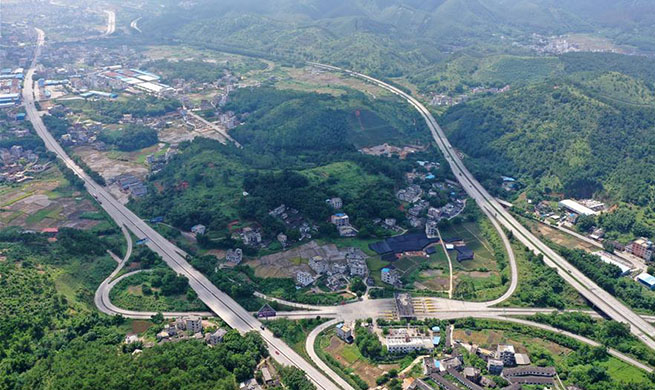
The town nowadays is connected by highway and a rapid channel to the county seat. The conference memorial hall, ancient town and hotspring resorts have attracted tens of thousands of visitors.
Houchang's poverty rate has dropped from 14 percent in 2014 to 0.7 percent today. The town that witnessed the prelude to a great turning point in the nation's history has accomplished a great transition of its own.
"My grandfather often told me to remember the Red Army -- one should not forget the well-diggers when drinking from this well," said Li Wenquan, who operates a local restaurant.
The Red Army distributed grains to the public at Houchang, among whom was Li's grandfather. He volunteered to guide the Red Army to the Wu River, who left him a few silver dollars.
"These are treasures that our family will pass down for generations," said Li Wenquan, adding they symbolized the cordial relations between the Red Army and the people.
When Fang Dezhong stepped onto the road of the Long March, he was only 17 years old.
According to Fang Yuanqin, her late father joined the Red Army in order to ensure that everyone would have clothes to wear, food to eat and a house to live in.
Fang's father fell into a coma during a fight at Weng'an. He stayed there with assistance from local people.
His biggest regret was that he did not complete the Long March, according to Fang Yuanqin, adding one of his grandsons joined the PLA, aiming to finish his incomplete journey.
FISH AND WATER
Upon the Red Army Hill of Zunyi, stands a statue of a Red Army medical orderly, Long Siquan.
Helping cure local residents, he was unable to rejoin the troops in time and was killed by the enemy. With him worshipped as a "Bodhisattva of the Red Army," the feet of the statue have changed color because so many locals rub them for luck.
Kong Xianquan, the first curator of the Zunyi Meeting Memorial Hall, was seriously wounded during the Long March. After he passed away in 1988, his granddaughter Kong Xia found six pieces of shrapnel in his ashes.
Every time Kong Xianquan went to the market, he would deliberately pick withered vegetables left in the afternoon, because those were difficult for farmers to sell, which made his wife both laugh and cry, said Kong Xia.
"The Long March is a baton in the relay of history. We must work steadfastly and pass on the spirit from generation to generation. Everyone should follow their own 'Long March,' so that everyone can live a better life," Kong Xia said.
YOUNG INHERITORS
Every Saturday, visitors to the Red Army Street in Zunyi are attracted by dozens of old people, dressed as members of the Red Army, singing red songs.
Xia Qingyuan and Luo Guanghua established the troupe 15 years ago. "We will not forgot what the Red Army has done for the people of Zunyi."
According to Xia, one of Zunyi's top elementary schools invited the troupe to perform for their students on International Children's Day this year.
The performance was greeted by thunderous applause from the pupils. The school is planning to send students over to the troupe and learn more from the performers.
Such interactions warm Xia's heart. "Our greatest wish is to demonstrate the charms of red culture and enable the red genes to be passed on."
"The perseverance shown by the Red Army during the Long March can be of great help to me when there are bumps on the road," said Tang Xin, a fourth grader in Zunyi.
Before He Mulin passed away in 1979, he stated that his last wish was to be buried in Qinggangpo, alongside his fallen comrades.
His daughter-in-law said her grandson, now six years old, often accompanies her to walk along the path trodden by the Red Army. "My great-grandfather was a Red Army solider" is a great source of pride for the child.