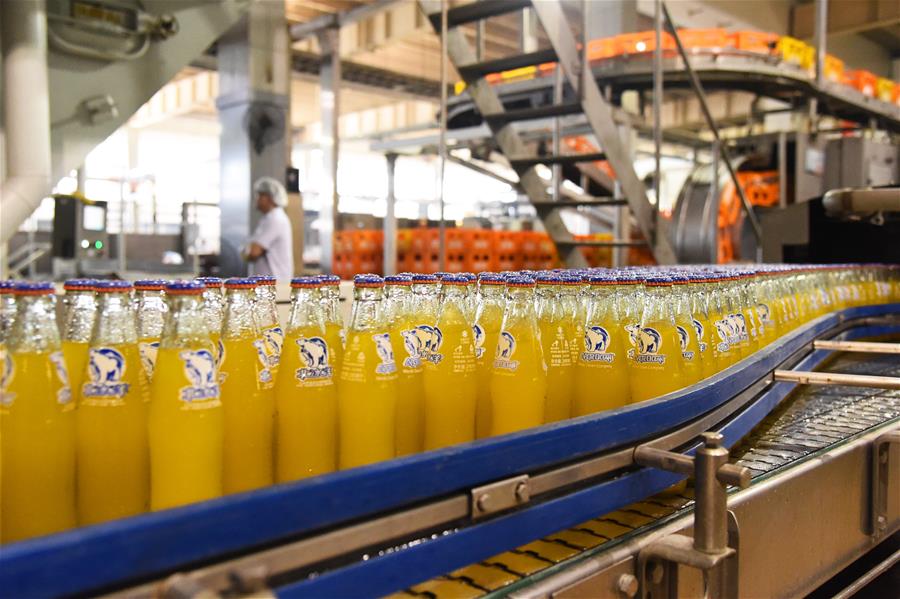
Photo taken on June 21, 2019 shows the Arctic Ocean soft drink production line in Daxing District of Beijing, capital of China. With an iconic polar bear logo, the traditional soft drink brand Beibingyang, or Arctic Ocean in English, garnered around 12 million cases in sales last year, up 30 percent year on year, after over a decade of silence in the market. (Xinhua/Ren Chao)
BEIJING, July 4 (Xinhua) -- Dong Miaomiao, a 34-year-old Beijinger, opens a glass bottle of Beibingyang, releasing pressure slowly and pouring the highly carbonated orange soda into his mouth. The taste, tinged with nostalgia, immediately quenches his thirst.
"Beibingyang was a highlight of my childhood," Dong said. "When I would finish the drink, I used to lick the straw. It was a taste of happiness."
With an iconic polar bear logo, the traditional soft drink brand Beibingyang, or Arctic Ocean in English, garnered around 12 million cases in sales last year, up 30 percent year on year, after over a decade of silence in the market.
EBB AND FLOW
The traditional brand went through ebb and flow. The predecessor of Beibingyang was an ice-making factory built in 1936. The factory closed down in 1947 due to insolvency.
In 1949 when the People's Republic of China was founded, the Chinese people faced a devastated country that needed to be rebuilt from scratch after decades of warfare and chaos.
In the same year, the ice-making factory resumed production despite a lack of funds, materials and talent, and started producing soft drinks in 1951.
Beibingyang soft drinks, once served at state banquets, were considered luxury items at that time.
The reform and opening up launched in the late 1970s solved food and clothing problems that haunted Chinese for thousands of years. As people had more money, the fizzy drink was accessible to more common households.
Individual peddlers often waited in shoals in front of Beibingyang food company for the drinks. The soft drink garnered an annual output value of over 100 million yuan (around 15 million U.S. dollars) in 1988.
"When my family purchased a refrigerator, I always put a bottle of Beibingyang inside the fridge. Our tough years tasted sweet because of the soft drink with bubbles," said Xing Huiming, Party chief of Beijing Yiqing Food Group Co., Ltd., the parent company of Beibingyang.
However, the popular fizzy drink disappeared off the shelves of Chinese stores in the 1990s due to reasons such as the company's restructuring, the impact of foreign beverages like cola and people's changing consumption habits.
COMEBACK AND CATCH-UP
"We learned management and techniques from the West, but we lost our original advantages," Xing said.
In the 2000s, Beibingyang decided to resume production and revive the traditional brand. They sought equipment manufacturers and a raw materials base, tested the formula and improved the design of the glass bottle, such as printing braille on bottles.
After dozens of rounds of discussions and more than 100 adjustments of tastes, the traditional soft drink brand made a comeback in 2011.
Beibingyang achieved profitability only two months after it resumed production.
"In 2013, the demand exceeded supply, and fake Beibingyang fizzy drinks even appeared in the market in 2014," Xing recalled.
The company increased output and introduced other fruity blends, such as loquat, plum and sugar-free orange soda. Besides glass bottle drinks, drinks in ring-pull cans were also produced to attract younger customers.
"Taste is the soul of soft drink, but the taste will change with times. As Chinese people get richer, consumers are more prone to healthy drinks," Xing said.
Beibingyang started exploring markets outside Beijing since 2017. Currently, it has built 180 dealerships in cities across China and sold its products to 12 countries such as the United States, Australia and France.
The company plans to build manufacturing bases in the southwest and south of China to further expand domestic markets.
"Old brands should catch up with the times and keep innovating," Xing said. "Beibingyang's comeback was not only driven by Beijingers' nostalgia but also by innovation."??