




STAHLSTOWN, the United States, May 27 (Xinhua) -- The U.S. government's latest move to blacklist Huawei has forced the Chinese telecom giant's business partners in the United States to brace for mounting uncertainty.
Among them is LHTC Broadband, a telecom company focused on the rural area of the U.S. state of Pennsylvania. It offers telephone, TV and Internet services to 7,000 rural locations, of which 1,600 are served with Huawei gear.

Photo taken on May 24, 2019 shows Huawei equipment at South Canaan site of LHTC Broadband company in South Canaan Town, Pennsylvania, the United States. (Xinhua/Liu Jie)
"WE STILL HAVEN'T SEEN ANY PROOF"
What has perplexed LHTC CEO James Kail is that he has never seen an issue of security threat in Huawei equipment -- not only in the past few months in which such accusations have been heated up by the U.S. government, but also throughout the last five years of partnership with Huawei.
U.S. President Donald Trump on May 15 declared a national emergency over what he called threats to U.S. technologies. The U.S. Department of Commerce on the same day put Huawei and its affiliates on a blacklist, meaning the sale and transfer of U.S. technologies to Huawei must be approved by the federal government.
"We haven't had any issue with the equipment itself, and on top of that, the pricing was very competitive," Kail told Xinhua, recalling that it was a prudent business decision for LHTC to choose Huawei as a supplier five years ago.
As of the end of 2018, 90 percent of LHTC's fiber-deploying project using Huawei solutions has completed, and the remaining 10 percent is expected to finish by 2020.
"It's been five years and we still haven't seen any proof (of security threats)," Kail said.
That said, the ban could deal a severe blow to LHTC, which has only 65 employees. To take out all the Huawei equipment, Kail said, "will be obviously a significant hardship for a small company like us."

LHTC CEO James Kail speaks during an interview in Stahlstown, Pennsylvania, the United States, May 23, 2019. (Xinhua/Liu Jie)
A COSTLY & PROBLEMATIC BAN
According to Kail's estimates, it will take LHTC about one year to completely replace the existing Huawei equipment if the company focuses solely on that. The cost is expected to total 400,000 to 500,000 U.S. dollars, he added.
Apart from the replacement cost, what also concerns Kail is a potential sudden suspension of Huawei's technical support once the restriction kicks in.
The Commerce Department last week granted a 90-day window for U.S. mobile phone companies and broadband providers tied to Huawei "to make other arrangements."
"If we weren't able to have any technical support for upgrades because Huawei was shut off, that would be another problem," Kail said. He added that LHTC is closely monitoring the situation because of its investment in Huawei and "the potential significant impact on our company."
Noting that it has been a good partnership over the last five years that LHTC had with Huawei, Kail said Huawei has been "very responsive" when problems occur.
In South Canaan town, a five-hour drive to the northeast of Stahlstown, about 1,000 residents are using LHTC services supported solely by Huawei equipment.
Standing next to the two sets of Huawei equipment at the office, Bonnie Bond, network supervisor at LHTC's local branch, told Xinhua that each set of the equipment has the capacity to serve 1,024 customers, and that each port with which a cable is connected serves 32 customers at the home end simultaneously.
"So as we switched one of those ports, those 32 customers would be out of service until we were able to change their equipment in their house," the technician said.
In addition to South Canaan, LHTC has three more such Huawei sets in the nearby community of Waymart Borough, according to Bond.
Bond said she is "very concerned" that once Huawei is banned, her customers will not be able to watch TV or surf the Internet anymore.
"Hopefully they would bear with us and stick through, but there is competition out there as well," she added.
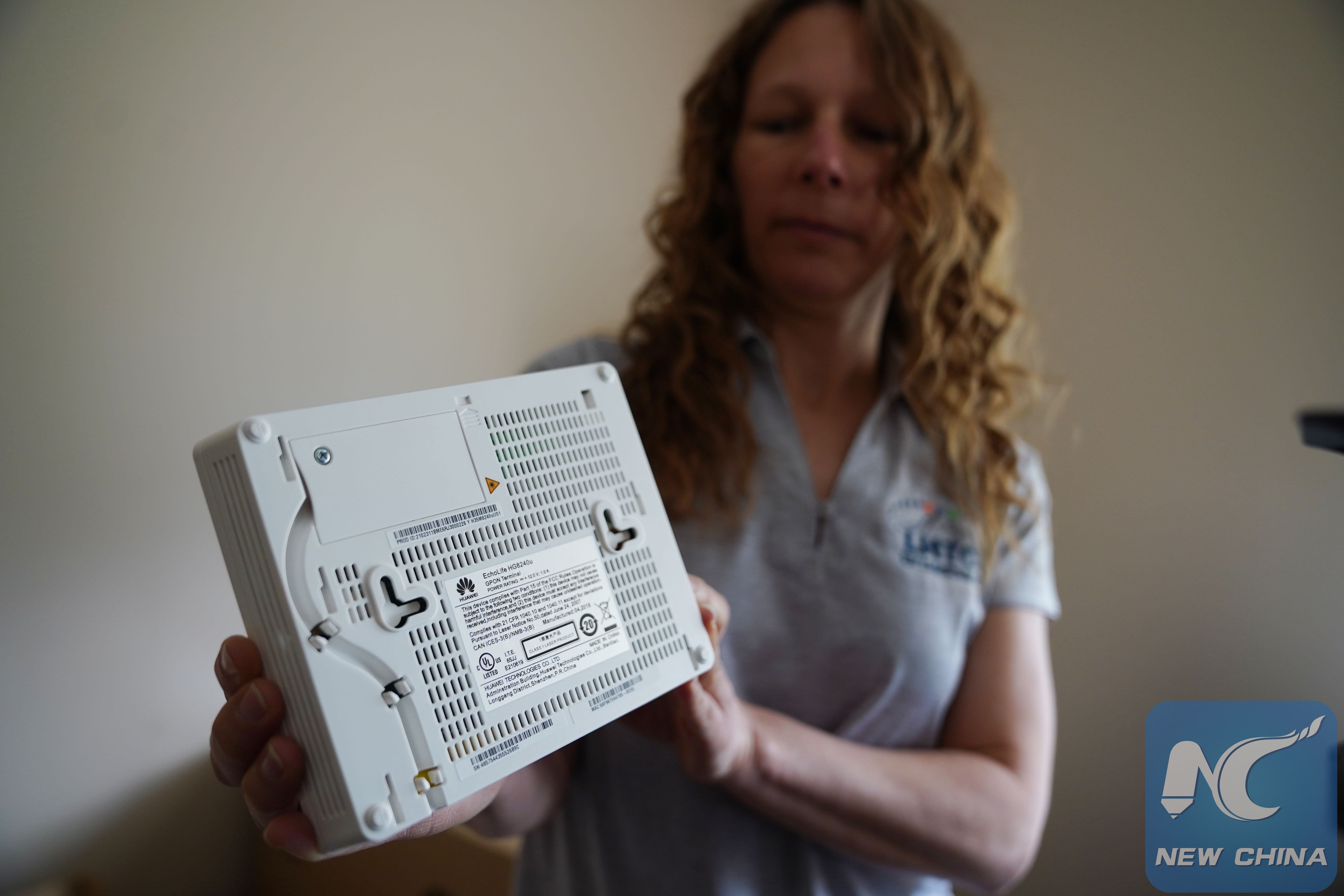
Bonnie Bond, network supervisor at LHTC's local branch, shows a Huawei GPON terminal during an interview in South Canaan Town, Pennsylvania, the United States, May 24, 2019. (Xinhua/Liu Jie)
BIG U.S. COMPANIES DON'T SERVE RURAL AREAS
Kail said LHTC is one of the first small telecom companies in rural America to partner with Huawei, partly because major U.S. telecom carriers do not bother to serve residents in scarcely populated suburbs.
"They never wanted to serve these low density areas," Kail said. "And if they do serve them, they don't serve them very well, because they have a different business model."
Those big companies, according to Kail, are not participants of the U.S. Federal Communications Commission's (FCC) Universal Service Fund, which subsidizes small rural carriers so that they are financially able to provide telephone and broadband services to rural Americans.
"The larger carriers don't have this model, so they're going to focus on doing business in the city," Kail said. Instead of line-based services, big companies like Verizon by and large choose to do wireless, which is not feasible in areas with a low density of population, he added.
By contrast, Huawei has prioritized entering U.S. rural market. Andy Purdy, chief security officer of Huawei Technologies USA, told U.S. media in an interview in early May that Huawei has about 40 customer companies in rural America.
According to Purdy, Huawei has 1,500 employees in the United States, a strong research and development presence in the country, and purchased 11 billion dollars' worth of components from U.S. firms in 2018.
Huawei and ZTE, another Chinese wireless networking gear provider, now serve about a quarter of the 55 member companies of the Rural Wireless Association (RWA), which in December 2018 urged the FCC not to ban Huawei and ZTE from the U.S. market.
"We believe our technologies are essential to farmers, schools, citizens, companies in rural parts of the United States, and we hope we can maintain that service," Purdy said.
According to RWA estimates, the total cost for small U.S. wireless carriers to replace gears of Huawei and ZTE would amount to 800 million to 1 billion dollars. Analysts say such large-scale supply chain adjustment would compel some small companies to file bankruptcy.
On top of a potential cut-off of wireless signals because of the Huawei ban, U.S. farmers have also been struggling to cope with the escalation of the U.S.-initiated trade war with China, which is depriving their products of access to the Chinese market.
Paradoxically, the two-fold pain is inflicted by their own government. Enditem
(Video reporters: Yan Liang, Hu Yousong, Deng Xianlai, Liu Jie; Video editors: Li Qin, Yin Le)
