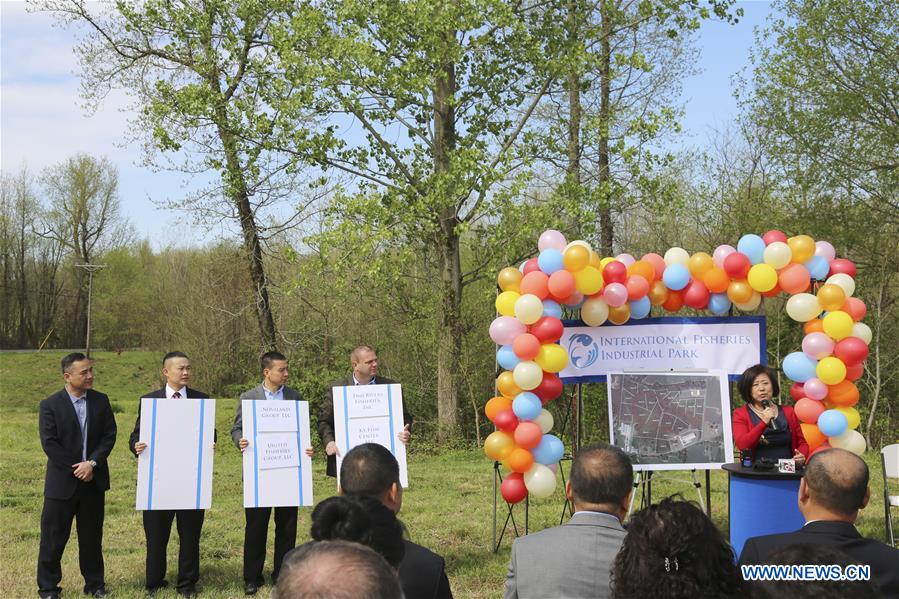
Angie Yu (1st R, Rear) , president of the Two Rivers Fisheries, delivers a speech at the opening ceremony of the International Fisheries Industrial Park in Wickliffe, Kentucky, the United States, April 12, 2019. The birth of an industrial park devoted to Asian carp processing in the southeastern U.S. state of Kentucky has added to hopes that its prowess in turning the bony fish into delicacy increases the odds of winning the battle against the invasive fish in the Mississippi River. (Xinhua/Xu Xingtang)
by Xinhua writers Xu Feng, Xu Xingtang
NEW YORK, April 22 (Xinhua) -- The birth of an industrial park devoted to Asian carp processing in the southeastern U.S. state of Kentucky has added to hopes that its prowess in turning the bony fish into delicacy increases the odds of winning the battle against the invasive fish in the Mississippi River.
On April 12, the International Fisheries Industrial Park, sitting on 64 acres of wooded land in Wickliffe City, Ballard County, came online. With the newly arrived Chinese makers of fish ball, smoked fish, dried fish, fish sauce and a manufacturer who turns fish guts into organic fertilizers, the industrial park achieves vertical processing integration and is waste-free.
Angie Yu, president of the Two Rivers Fisheries which has been operating since 2012 and is the undisputed nucleus of the new business cluster, expects a surge in her company's Asian carp processing -- a combined total of 78 million pounds in six years.
The Chinese American businesswoman believes that if the industrial park, the first of its kind in the United States, proves to be a success, its experience can be copied elsewhere and helps the United States decisively reduce the population of Asian carp ravaging the Mississippi River and surrounding waters.
CARP ATTACK
The Asian carp, collectively referring to a group of four species of carp -- Bighead, Silver, Grass and Black carp -- were introduced to the United States in the 1970s for algae and waste treatment purposes. Flooding and accidental releases brought them into the Mississippi River system.
Over the years, the Asian carp have multiplied rapidly and a lack of predators means they can easily grow to an average size of 30 pounds, out-competing indigenous fish species in the water.
U.S. authorities and fish industry fear that the Asian carp's northward proliferation, if not curbed, spells disaster for the 7-billion-U.S.-dollar fish industry of the Great Lakes region, affecting species such as the highly-prized walleye and trout.
Costly measures including electrical barriers and dam-like structures have been used and dubious methods such as spraying poison that specifically targets the Asian carp have also been proposed, still, one Asian carp was reportedly caught only 9 miles from Lake Michigan in 2017.
EAT THEM TO DEFEAT THEM
To make a virtue of necessity, harvesting the Asian carp as a food source has emerged as a viable solution.
Due to their complex bone structure, however, the Asian carp have never been a huge hit with the American diners. Asian carp processors along the Mississippi River are mainly targeting markets outside the United States.
Over the past seven years, Yu's company has harvested 10 million pounds of Asian carp out of the Mississippi River, which were sold to 11 countries, mainly in the Middle East and Europe. The No. 1 Asian carp exporter in Kentucky aims to process 5 million pounds this year and eyes an annual production of 20 million pounds by 2024.
Much to her dismay, Two Rivers Fisheries has not had the best luck in China, one of the world's major fish consumers. Her wild caught carp are not selling well in China despite their obvious advantage over farm-raised carp. When her fish entered the China market, they were in the frozen form, unable to impress the Chinese customers who always prefer live fish.
The situation is set to change as value-added products such as fish balls and dried fish made with the new industrial park's deep processing ability are niche market in China.
Given the enormous size of the Chinese market, U.S. fish industry may finally breathe a sigh of relief as the percentage of Asian carp in the Mississippi River will very likely go down.
Fred Allen, a U.S. chemist and sustainability advocate, told Xinhua that Asian carp are great and nutritious fish rich in omega-3 fatty acids.
"We need to educate people about their benefits," he said, noting that "carp" is a four-letter curse word for many people due to its popular association with "trash fish," and some rebranding may be needed in Asian carp marketing.
He added that initial progress has been made in cafeterias of some U.S. colleges as young students are more adventurous and open to trying new things.
ECONOMIC AND SOCIAL BENEFITS
The industrial park, when it operates at its designed capacity of housing 12 tenants, will create at least another 150 full-time jobs, according to Yu.
"I thank you for what these new jobs will mean to so many individuals who look forward to new opportunities to work in their home county," said Senator Rand Paul in a congratulatory letter to the industrial park's launching.
"Angie is an asset to our community," Lynn Lane and Diana Abell, Wickliffe residents, told Xinhua that locals unanimously root for Yu's success.
Jiang Chengguang, a businessman from China's Guangxi whose plant will produce fish balls, is impressed by the natural beauty of the industrial park area, especially the little streams and deer tracks. He is working with Yu on the overall design of the park, to ensure it retains its natural appeal so that their industry cluster may also double as a tourist attraction.
If everything goes well, Yu believes her business will soon expand and a branch in neighboring Arkansas is in the cards, helping the state deal with its share of the "Asian carp crisis" and create jobs at the same time.
"Our mission is to reduce, reuse and redefine the Asian carp," the 62-year-old said.
(Xinhua reporters Xu Jing and Miao Zhuang also contributed to the story)