by Yu Qianliang, Abu Hanifah
JAKARTA, April 13 (Xinhua) -- Chairman of the Indonesia Investment Coordinating Board Thomas Lembong said the China-proposed Belt and Road Initiative (BRI) is one of the world's most important initiatives in the 21st Century fit to galvanize the stagnant world economy.
"As global economy now encounters drastic downturn, the world now needs a new stimulus. The BRI is the correct concept as it complies with the needs of both developed and developing countries," Lembong said in an interview with Xinhua.
The BRI that highlights infrastructure projects would eventually stimulate economic activities and share the prosperity in countries participating in the BRI cooperation, he added.
Having visited China several times, Lembong believed that China is capable of intensifying BRI cooperation with relevant countries and carrying out the infrastructure projects for common prosperity.
"I was fascinated by the rapid development in China that was also seen in cities deep inside its central region, not only in Beijing, Shanghai, Guangzhou and Shenzhen that we used to see," the chairman recalled his visit China.
He added that Chongqing and Chengdu in southwestern China have also been transformed to modern cities due to China's intense development activities.
The Silk Road Economic Belt and the 21st Century Maritime Silk Road Initiative, proposed by China in 2013, is aimed at building a trade and infrastructure network connecting Asia with Europe and Africa along the ancient trade routes of the Silk Road to seek common development and prosperity.
Lembong said Indonesia is honored to be chosen as the country that hosted the first announcement of the 21st Century Maritime Silk Road during Chinese President Xi Jinping's visit to Jakarta in 2013.
Nowadays, China's BRI is still relevant to Indonesia as it can be aligned with Indonesia's Maritime Fulcrum initiated by Indonesian President Joko Widodo, the chairman said.
Indonesia's Maritime Fulcrum emphasizes on efforts to use the nation's vantage geographical position, that sits between two continents and two oceans, as an essential factor to prosper the archipelagic nation.
Putting the BRI and Maritime Fulcrums into a synergy so as to benefit people in the two economies is an excellent idea as Indonesia and China have great potentialities with their respective exceptional characteristics, he said.
"Indonesia is the largest archipelagic country and the largest economy in Southeast Asia, while China is an economic powerhouse in the world. Indonesia is also one of China's closest neighbors along the BRI sea lanes," Lembong said, describing huge potentialities that Indonesia and China can tap on by integrating the two initiatives.
He added that propping up the connectivity would further enhance collaboration between the two countries under the merged visions. "The advanced connectivity between the two countries would improve power of both fulcrums," he pointed out.
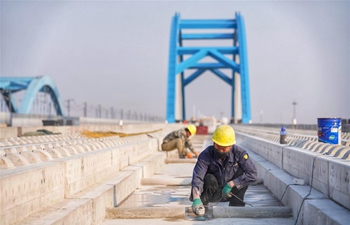
As part of countries embracing the BRI, Indonesia now hosts Jakarta-Bandung high-speed railway project that will practically show the actual benefit of the BRI in Indonesia, he said.
The project, expected to be completed in 2020 and be operational in 2021, will make Indonesia the first country in Southeast Asia to operate the high-speed train.
The high-speed railway will substantially boost the economy in a 142-km corridor served by the advanced transportation system as it can ferry people between the two major cities in around 35 minutes.
"I personally think this project is correct and most needed in Java Island that hosts two-thirds of 265 million population in the country. I am sure that high-speed railway is the correct answer to solve urbanization problem in Indonesia," Lembong said.
Apart from the high-speed railway project, he said further talks between Indonesia and China counterparts are underway to develop Indonesian provinces along the BRI sea lanes - North Sumatra, North Kalimantan, North Sulawesi and Bali.
Trade, Investment and Tourism are three elements highlighted in BRI cooperation to develop those Indonesian provinces, he said.
Noting global concerns on environmental protection and climate change, Lembong suggested that massive implementation of environmental friendly technologies be used in BRI projects.
"We know that China is an ultimate producer of solar panels and wind farms in the world. We also know that China is the No. 1 producer of electric vehicles. I see a tremendous opportunity to address these environment and climate change concerns if we can expand use of green technology in BRI projects," he said.
"People in Indonesia are very much enjoying the benefits from increasing arrivals of Chinese tourists and Chinese high-quality products. Chinese investments are also creating more jobs," he said.
"If people here see the good results from the infrastructure, growing number of tourists as well as benefits from increasing investments, they will quickly understand the meaning of the BRI."