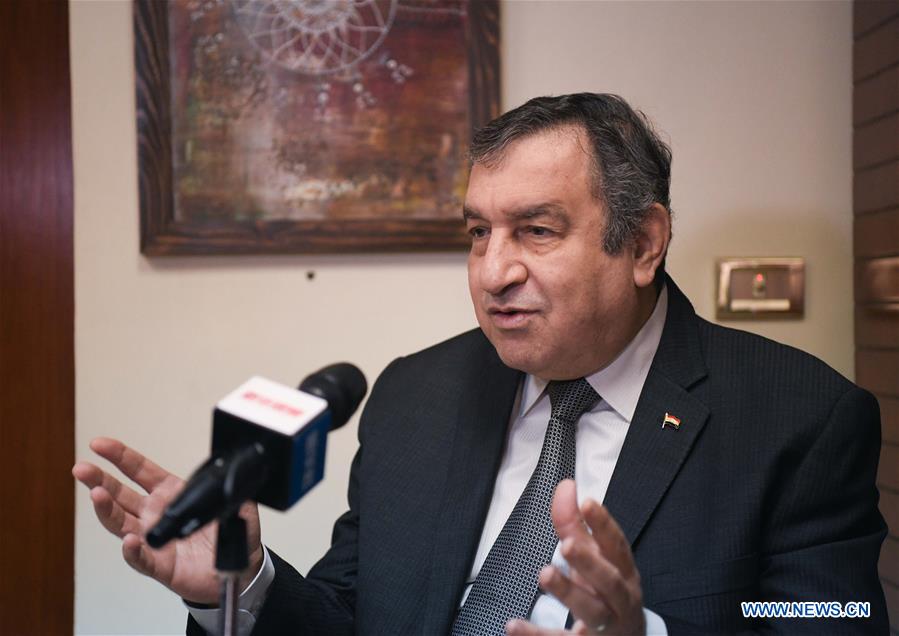
Essam Sharaf, former Egyptian Prime Minister, speaks during an interview in Cairo, Egypt, on Dec. 30, 2018. The principles of the China-proposed Belt and Road Initiative (BRI) are almost identical to those of the 17 United Nations Sustainable Development Goals (SDGs), as they both seek to achieve a better and more sustainable future for all, Sharaf told Xinhua in a recent interview. (Xinhua/Wu Huiwo)
by Mahmoud Fouly
CAIRO, Jan. 4 (Xinhua) -- The principles of the China-proposed Belt and Road Initiative (BRI) are almost identical to those of the 17 United Nations Sustainable Development Goals (SDGs), as they both seek to achieve a better and more sustainable future for all, former Egyptian Prime Minister Essam Sharaf told Xinhua in a recent interview.
"The BRI is a practical implementation of the SDGs and turns them from local to international, for the UN set the goals but did not outline a cooperation mechanism between states to achieve them," said Sharaf.
Proposed by China in 2013, the BRI refers to the Silk Road Economic Belt and the 21st Century Maritime Silk Road, which aims to build a trade and infrastructure network connecting Asia with Europe, Africa and beyond along the ancient trade routes of the Silk Road.
Sharaf, also head of Sharaf Foundation for Sustainable Development and a committee member of the Silk Road NGO Cooperation Network, highlighted that the BRI is based on five key principles to be maintained among participant states, including policy coordination, infrastructure connectivity, global trade and investment, finance integration and cultural dialogue.
"The BRI five principles are almost identical with the UN-proposed 17 SDGs, for the BRI seeks economic and social development for all, which is in line with the main theme of the SDGs," he said.
The 17 SDGs include no poverty, zero hunger, good health and well-being, industry, innovation and infrastructure, decent work and economic growth, and partnerships to achieve the goals.
"I believe the 17 SDGs can be fully achieved through the BRI," the former Egyptian prime minister said.
He added that Egypt is a main partner under the BRI due to its strategic location as a portal for Africa, the Arab world and the Middle East with the Suez Canal as a vital waterway for international trade.
"China considers Egypt a key state in five circles: Arab states, African states, Islamic states, Mediterranean states and developing states," Sharaf noted, describing China as "a super developing state."
Sharaf paid his latest visit to Beijing in mid-December 2018 to attend the first meeting of the Advisory Council of the Belt and Road Forum for International Cooperation, a non-profit consultation agency whose main function is to provide intellectual support for the development of the forum.
The dozen-member council consists of veteran politicians, diplomats, scholars and experts including former prime ministers of Egypt, Italy and France, a former Russian foreign minister, a former Indonesian trade and tourism minister, a former World Bank vice president and others.
"The BRI has many representatives from European states, which is a good thing. I believe that Europe has started to be more inclined toward the East, particularly in the light of the recent U.S. policies," Sharaf said.
Sharaf said that the BRI can benefit developing states with China's experience in its transformation from a poor country to the world's second economy.
"The philosophy of reform and opening up adopted by China in the past 40 years was based on local growth side by side with openness to the world," he said.
China's focus on local development led to the rise of "socialism with Chinese characteristics" by relying on the unique social, cultural, political and economic characteristics of the Chinese society, he underscored.
He said that China has its own political, economic and social systems that are different from those of Western states, which helped lift most of the Chinese population out of poverty.
"The miracle of China's development was a result of their implementation of unique policies and mechanisms different from those of the West," Sharaf said.