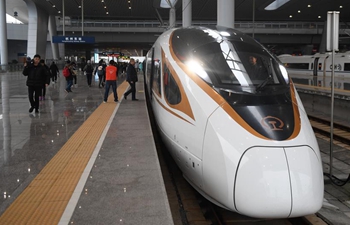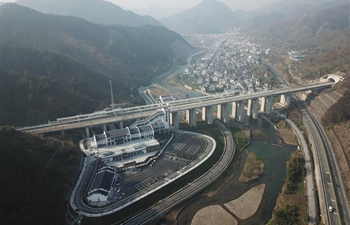
NEW YORK, Dec. 25 (Xinhua) -- The China-proposed Belt and Road Initiative (BRI) is bringing the Asian country's infrastructure capital and know-how to developing countries involved in its expansion, a renowned U.S. scholar has said.
"China has shown itself to be a vivid example of the benefits that can flow from the active hand of government in investment in infrastructural development," Sourabh Gupta, a senior fellow at the Washington-based Institute for China-America Studies, said in a recent interview.
"As the Belt and Road Initiative is extended and expanded overseas, it will afford a similar foundation on which developing countries can jump-start their own development on lines achieved by China over the past three decades," he said.
Proposed by China in 2013, the Belt and Road Initiative, which refers to the Silk Road Economic Belt and the 21st Century Maritime Silk Road, aims to build a trade and infrastructure network connecting Asia with Europe and Africa along the ancient trade routes of the Silk Road.
Development under the initiative's transnational framework involves a variety of countries, and China has the finance, skills and experience to make infrastructure growth a reality, Gupta said.
The key is early-stage investments in hard and soft infrastructure, he noted.
While trade liberalization and market forces are important for resource allocation and growth, inclusive industrialization-led development "cannot be left to market forces alone," he said.
"The active hand of government is required to overcome a host of deficiencies related to institutional shortcomings, rent-seeking, and a general lack of competition," he said.
It is also important to ensure that the infrastructural investments under the banner of BRI are "well-designed and productivity-enhancing," given that these investments have long gestation periods, and the financing that is provided needs to be paid off from the productive assets created, said the expert.
"Creating long-term productive assets requires wise and patient capital -- a difficult challenge, and this is the reason that there is such a vast global deficiency in infrastructure investment. So Chinese capital and know-how is very important to fill this gap," he said.
The world's infrastructure spending is insufficient. For example, 5.5 trillion U.S. dollars are needed between now and 2035 to fill the gap in global infracture spending, according to McKinsey Global Institute research.
"But for the gap to be filled efficiently, it also requires that the feasibility of projects is conducted with great due diligence and does not add to the creation of unproductive assets that could saddle countries with excess debt," Gupta said.
"In regard, it is important to stock-take the achievements and progress under BRI so that the initiative can be rolled out even more effectively and on an even more greener and sustainable basis," he added.