
 ?
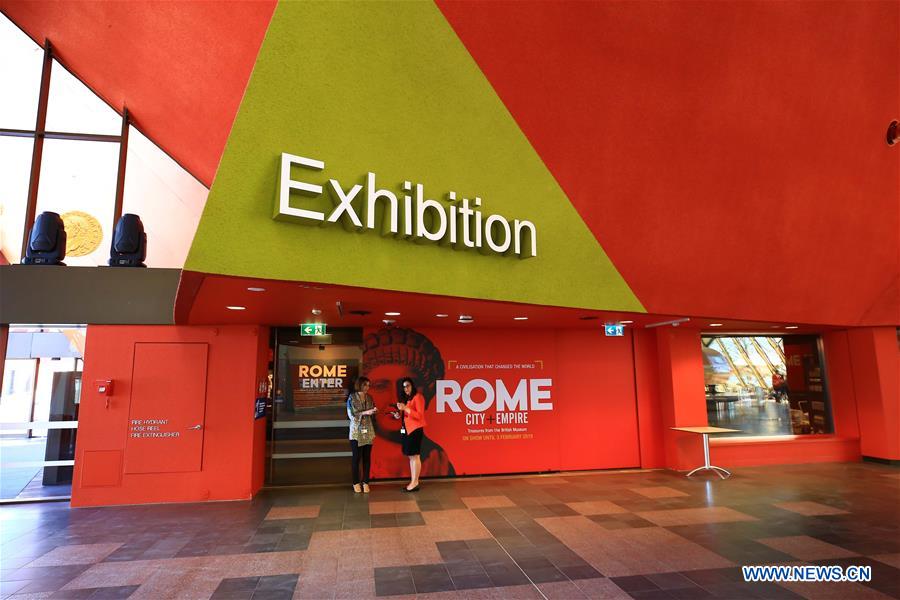
?Photo taken on Sept. 20, 2018 shows the entrance of the exhibition "Rome: City and Empire" at the National Museum of Australia in Canberra, Australia. Two wall paintings from Pompeii, a frieze featuring a rare depiction of female gladiators and sculptures of figures dressed in Persian style were among the treasures brought by the British Museum to National Museum of Australia in Canberra. (Xinhua/Pan Xiangyue)
by Bai Xu
CANBERRA, Sept. 20 (Xinhua) -- Two wall paintings from Pompeii, a frieze featuring a rare depiction of female gladiators and sculptures of figures dressed in Persian style were among the treasures brought by the British Museum to National Museum of Australia in Canberra.
The exhibition, "Rome: City and Empire," will start on Friday and will run until Feb. 3, 2019. It put on display more than 200 objects dating from the 9th century BC to the late 6th century AD.
"The story of Rome and its vast empire continue to captivate and intrigue people almost 3,000 years after their foundation," said Dr. Hartwig Fischer, director of the British Museum.
Dr. Mathew Trinca, director of the National Museum of Australia, said that the Roman Empire's legacy "endures in modern Australia today, encompassing our languages, our art and architecture, the design of our towns and cities and the laws by which we live."
The largest statue of the show is the colossal Roman magistrate from 70 to 90 AD, which featured an adult male in a toga and holding a scroll standing at 2.41 meters tall.
Another imposing marble statue is a priestess from 25 to 50 AD, which was rarely on display even in London. "It was prepared specifically for the exhibition," said Dr. Thorsten Opper, British Museum senior curator, head of the museum's Roman section. "It took us hours of conservation to get her back to stage."
He also liked two colored wall paintings from Pompeii, the Roman city destroyed when Mount Vesuvius erupted in 79 AD.
"It feels like a moment frozen in time," he said. "I was really touched by this, a swallow and a sparrow. I always think when I look out of my kitchen window in the morning in Oxford, that is what I could see now."
The exhibition also includes a massive marble head of Empress Faustina I of 140 AD, which stands 1.7 meters tall and weighs 1,000 kg. The head came from a statue that once stood in the temple of Artemis at Sardis in Turkey.
"She was the wife of Emperor Antoninus Pius. At that time we know there are record of delegations between Roman Empire and China," Opper told Xinhua. "It gave you a sense of the diversity and the vast region of Rome."
Roman Empire was vast at that time, "from Scottish borders in the North to Sahara Desert in the South, from the Atlantic Ocean in the West to the Caucasus Mountains and Persian Gulf in the east," Opper said.
So the exhibition also demonstrated diversity of the culture within the empire. "We have objects almost from every province of Rome, from Europe, from Africa, from the Middle East. There is a gold coin excavated in India. The Romans paid for pepper and luxury goods," said the curator.
Opper especially talked about three exotic statues found from tombs between 200 and 273 AD in Palmyra, Syria. Pointing at a female image, he said that yellow pigment is still visible on the elaborately decorated headband of the woman, which means that objects like this would have originally been colored.
Next to the exhibit there is a screen. Visitors could apply their own color scheme to the image on the screen.
Although thousands years have passed and gone are the days of the Roman glory, people have never ceased to make new discoveries.
Opper told Xinhua that a latest discovered object was a golden votive plaque for the goddess Seuna, which was found in England in 2003. "It was discovered by metal detector by enthusiasts," he said.
The Roman Empire also never ceased to impress people nowadays, according to Dr. Lily Withycombe, curator of the National Museum of Australia, citing Australian writer Colleen McCullough's Masters of Rome series and actor Russell Crowe's blockbuster Gladiator.
"Ancient Rome continues to resonate in Australia and in the world," she said.
Withycombe said one of her favorite exhibit was a large stone with the sculpture of female gladiators, found in Turkey. "It is such a surprising representation of women in the ancient world," she said.
"At the exhibition we not only have monuments like statues and architectural fragments from imperials palaces and villas, and also the everyday objects of the ordinary people," said Opper, the British curator. "Two thousand years disappear, and you feel you are there, having a dialogue with people who lived under the Roman Empire."