 ?
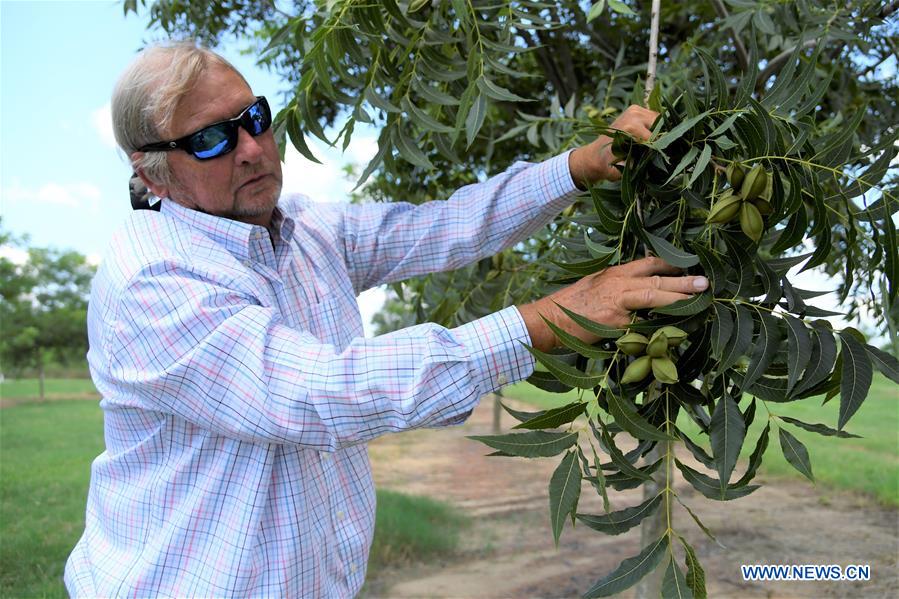
?Randy Hudson shows a bunch of pecan on his farm in the State of Georgia, the United States, on July 10, 2018. On average, a third of all pecans grown in the United States are sold in China, while for Randy Hudson, a U.S. pecan farmer in the leading producing state of Georgia, the amount is much more: practically all of his crop goes across the Pacific.
OCILLA, United States, July 16 (Xinhua) -- On average, a third of all pecans grown in the United States are sold in China, while for Randy Hudson, a U.S. pecan farmer in the leading producing state of Georgia, the amount is much more: practically all of his crop goes across the Pacific.
"I can tell you this, 99 percent of our production goes to China ... We've had a great working relationship with China over the years," Hudson said. However, the U.S.-led hike in tariffs is threatening to undo all that, leaving farmers like Hudson counting the cost.
On July 6, the United States added a 25-percent tariff on 34 billion U.S. dollars' worth of Chinese imports, claiming that an additional tariff on 200 billion dollars worth of goods is in the pipeline. Beijing responded in kind, hitting U.S. products, including pecans.
"I've just began a project to expand my storage room and pecan processing power three-fold last year," Hudson told Xinhua. Like most U.S. farmers expanding their business, Hudson is heavily in debt, with the almost 10-million-dollar project financed by loans.
Hudson said he was aware of Trump's campaign slogans in 2016, which called for tougher action against other countries who were "treating the United States unfairly," but "we never thought we would reach this level of intensity," said Hudson, whose family has raised pecan for over 150 years.
Pressured by sluggish domestic demand for pecan in the late 1990s, Hudson set out to seek for new fortunes in the Middle East, India and China. Unexpectedly, China responded enthusiastically to the product, which was completely new to the market.
Over the following decades, pecan sales grew "exponentially" in China, which allowed Hudson to gradually expand his pecan farm acreage from a few hundred to 2,500.
Pointing to a sizable collection of Chinese souvenirs and gifts in his office, Hudson said he has traveled to China more than 100 times, and had managed to forge strong ties with his Chinese partners.
Now, Hudson sells over 20 million dollars worth of pecan to China every year, yet the newly imposed tariffs will not only put his farm under severe financial strain, but also threaten to halt a booming pecan trade enjoyed by both U.S. farmers and Chinese consumers.
Hudson was not the only one worrying about the impacts of the tariffs. A drive around Ocilla, where pecans are most densely grown, expect to be bewildered by acres of newly planted seedlings, he said.
Hudson said the new trees are popular varieties in China, either producing large nuts or giving early harvests that can enter the market just in time for the Chinese New Year.
With the unexpected tariff, all of the efforts are put into jeopardy.Georgia Pecan, a bi-monthly magazine run by a local association, noted in a recent article that U.S. pecans are facing strong competition from other major growers, such as Mexico and South Africa.
"It is obvious in the near future U.S. growers will have serious competition for a limited Chinese market, with the worldwide production of export quality pecans exceeding the current demands of the China market," the article warned.
Hudson estimated that 30-40 percent of his sales will evaporate, registering a loss of 5-8 million dollars, significantly higher than his profit margin. In addition, imported parts that are crucial to the farming may also become more costly, further squeezing Hudson's margin.
"We're the collateral damage for a much bigger fight," Hudson lamented, saying that repeated appeals to lawmakers were not responded with concrete moves to steer the White House away from imposing tariffs.
"Only those of us who are most directly affected, the hog farmers, the wheat growers, the cotton and peanut growers... All of us are just now beginning to realize that this thing is real and that it's going to impact us directly," he said.
"The trickle down effects to others in the community is something that they have not seen, they have not felt and they did not realize what that impact is going to be, but it's going to happen," Hudson added.
Drawing on his years of experience dealing with the Chinese market, Hudson said, "Mr. Trump understands the art of deal in North America... but I'm not sure he understands the art of deal in Asia and our good friends in China."