ZHENGZHOU, June 12 (Xinhua) -- It has been almost 30 years, but Wang Hongbin from Nanjie, a village in central China's Henan Province, still has vivid memories of the day his instant noodles first went on sale.
"The streets were flooded with people," Wang recalled. "For most of them, it was the first time they had even seen instant noodles."
It was 1989 when China's reform and opening-up had been ongoing for around 10 years, but the variety of food in the stores was still limited, especially in rural areas. In this era however, culinary novelties were appearing all the time, some of the first signs of the prosperity to come. It was an exciting time.
Wang was among the first in his village to travel overseas. In 1988, Wang, then in his 30s, had a chance to visit Japan, where he had his very first taste of instant noodles.
"The savory smell of beef soup made the noodles seem irresistible and I was curious about how they were produced," he said.
On his return, after a little research, he found that instant noodles, invented by the Japanese in the 1950s, had been imported to China for several years, but they were only available in cities like Beijing and Zhengzhou, Henan's capital.
A year later, a company in the nearby city of Pingdingshan bought two production lines for instant noodles, but their efforts to popularize the convenience food failed. Wang and some friends from Nanjie took over the factory, and soon came the first packet of instant noodles from the village.
Targeting people in rural areas and students, the noodles were priced at 0.5 yuan per packet: cheap, but not very cheap in a country where many rural people still earned less than 3 yuan a day. Nevertheless, soon everyone was talking about Nanjie noodles.
In the 1990s, instant noodles became popular gifts for those visiting family and relatives in rural areas. People were often seen carrying sacks of noodles home for Chinese New Year gatherings. They were the in-thing at weddings and funerals. Noodle factories were must-see places for curious visitors, scholars and officials who wanted to learn from the noodle-makers' experiences.
Nanjie's star rose and the village was soon one of the wealthiest in the country. A full industrial chain grew up around instant noodles, including print shops and seasoning and packaging factories.
"Production lines increased from two to 36 at the peak. Last year, we sold noodles worth 600 million yuan (94 million U.S. dollars). About 80 million yuan of that came online," said Geng Fujie, head of sales for Nanjiecun Group.
Nanjie products are popular in southwest China's Tibet. Herders in Tibet always take Nanjie noodles when they go up hills in late spring to harvest caterpillar fungus, one of the most precious ingredients in traditional Chinese medicine.
"Our noodles took off in Tibet twenty years ago. We send 20 truckloads there every month during the season. Each truck carries more than 10,000 packets," said Geng.
But the road to success is rarely smooth. Between 2003 and 2010, sales plummetted as the brand "lost direction" while trying to compete with big names such as Master Kong. The village improved quality-control and set up an R&D center to develop new flavors, which gradually got the noodles back on chopsticks and forks all over the country. Annual production now can reach 120,000 packets per line.
But the market never stays still for long and new challenges constantly come to the fore. The flourishing food-delivery industry provides a rich variety of food at doorsteps, and as more people start to eat healthy the glory days of instant noodles may be behind them.
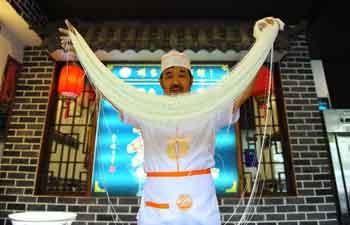
In response, Geng said they are working to understand to the appetites of younger customers. Nanjie instant noodles now come in more than 10 varieties, including freshly-made noodles and hot-dry noodles (a signature snack in Wuhan, capital of central China's Hubei Province).
"It's unfair to say instant noodles are unhealthy," said Geng. "As long as we can develop flavors and styles that appeal to today's consumers, we will find new markets."