
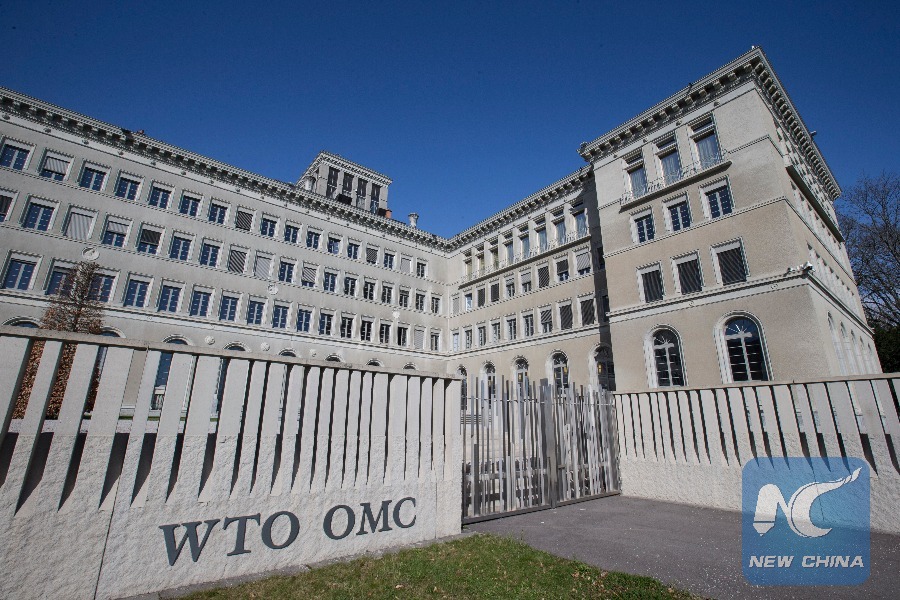
Photo taken on April 4, 2018 shows the World Trade Organization (WTO) headquarters in Geneva, Switzerland. (Xinhua/Xu Jinquan)
BEIJING, April 5 (Xinhua) -- Scholars and business leaders from around the world have blamed the United States for this week's escalation in trade tensions between Washington and Beijing that might affect some 100 billion U.S. dollars' worth of bilateral trade flow.
They say that U.S. unilateralism is harming multilateral global trade frameworks.
Under President Donald Trump's directive, the U.S. Trade Representative's office Tuesday unveiled a list of Chinese products on which it threatens to slap 25 percent import tariffs.
The list contained 1,333 items worth some 50 billion dollars in 2017, targeting mainly hi-tech and innovation sectors which China is committed to boosting over the next few decades under the state-led Made in China 2025 initiative.
Hours after Washington announced its proposed punishment, China hit back proportionally by rolling out its version of the list comprising 106 items involving key American exports to China, such as soybean, automobiles, aircraft and chemicals.
Beijing said it would slap a 25 percent duty on those products, also worth 50 billion dollars annually, as retaliation should Washington carry out its plan.
DISASTER FOR GLOBAL TRADING SYSTEM
The growing hostility between the world's two largest economies was triggered by the United States, which had not only ignored China's patience, but also showed insincerity.
In addition, Washington failed to take into consideration worries expressed by both the business community and academia that the exacerbating dispute may spiral into a full-blown trade war.
Klaus Wohlrabe, economist at Ifo economic institute based in Munich, Germany, said in a recent interview with Xinhua that Trump's tariff plan is a manifestation of unilateralism that will severely damage the multilateral mechanisms under the framework of the World Trade Organization (WTO).
He said while unilateral tariff measures may seem to gain the U.S. economy short-term benefits, they will have negative impacts on the economic well-being of the United States and other countries in the long run.
Trump's short-sighted policy, according to Wohlrabe, won't lead to a virtuous cycle of development and will see the international community renegotiate new multilateral trade agreements after a certain period of time.
According to a survey regarding the business confidence of 5,000 internationally active German companies, conducted by the German Chamber of Commerce and Industry (DIHK), 35 percent of them said they are willing to invest in the U.S. market in 2018, down from 37 percent the previous year.
"The new U.S. administration is causing uncertainties," said DIHK Deputy CEO Volker Treier about the result. "The protectionist trade policies could cut the international production chain," he added.
Zheng Yongnian, director of the East Asian Institute at National University of Singapore and a China expert, called the U.S. tariff measure a disaster for the existing global trading system.
The United States, Zheng said, does not intend to outright abandon multilateralism. Its dissatisfaction with international institutions like the WTO and the United Nations derives from the standpoint that multilateralism cannot serve U.S. national interests to the maximum and even harms them.
CALL FOR DIALOGUE
Despite Tuesday's announcement, the United States allowed 60 days, starting from March 22 when Trump signed the proclamation, for public feedback on the tariff proposal and didn't specify the exact date on which the measure will come into force.
Following the U.S. release of details on the tariffs, U.S. Treasury Secretary Steven Mnuchin said the administration "will continue to engage in discussion with China to address these issues of reciprocal trade," according to a Bloomberg report.
Meanwhile, the Chinese authorities said Beijing's tariffs will take effect when the U.S. side implement theirs.
"The date of implementation will depend on when the U.S. government imposes the tariffs on Chinese products," said a statement issued Wednesday by the Chinese Ministry of Commerce.
As both sides left open the door for communication, experts urged that talks for a negotiated resolution be held until it is too late to prevent global economic instability caused by a protracted downward spinning of China-U.S. commercial ties, which have become an increasingly vital component of the world economy.
"Escalation of countermeasures between China and the U.S. is not advised, as they are the two largest trading partners in the world," said Gamal Bayoumi, head of the Cairo-based Arab Investors Union.
In an interview with Xinhua on Wednesday, Gamal said, "We as developing states encourage dialogue and reject the use of world trade rules as means of protectionism and a ban on free trade."