




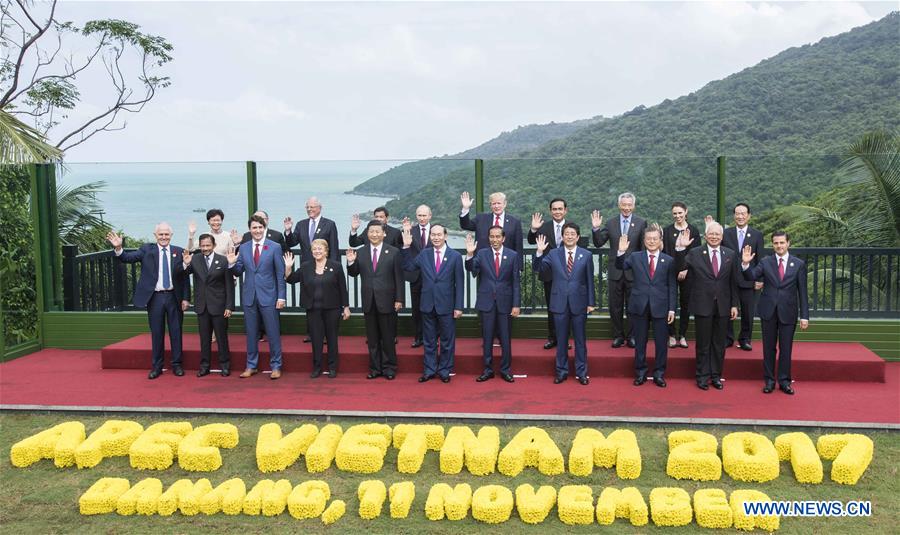
Chinese President Xi Jinping (5th L, front) poses for a group photo with other leaders and representatives from the Asia-Pacific Economic Cooperation (APEC) member economies at the 25th APEC Economic Leaders' Meeting in Da Nang, Vietnam, Nov. 11, 2017. (Xinhua/Li Tao)
BEIJING, Nov. 16 (Xinhua) -- Speaking at the past five Asia-Pacific Economic Cooperation (APEC) CEO summits, Chinese President Xi Jinping shared China's blueprint of openness and cooperation to energize regional economies and address changing global challenges.
Just as Xi said in this year's speech, "development is a journey with no end, but with one new departure point after another."
From Bali, Beijing, Manila, Lima to Da Nang, these five "departure points" recorded the Chinese leader's ever-innovating vision for APEC to achieve common development as partners, which has resonated with world business and political leaders.
DIAGNOSING WORLD ECONOMY
Noting the global economy is undergoing more profound changes, Xi said on Friday in Da Nang, a coastal city in central Vietnam, that the APEC economies must "closely follow the trend of the global economy, identify its underlying dynamics, keep to the right direction, and, on that basis, take bold action."
When illustrating the profound changes the global economy is seeing, Xi said the world should make economic globalization, which he called "an irreversible historical trend," more open and inclusive, more balanced, more equitable and beneficial to all.
"We should uphold multilateralism, pursue shared growth through consultation and collaboration, forge closer partnerships, and build a community with a shared future for mankind," Xi made such remarks regarding the system of global economic governance.
Two years ago, in the Philippine capital of Manila, Xi told the business community that the global economy, though on a course of slow recovery, had not secured a solid base and was still fraught with considerable destabilizing factors and uncertainties.
At that time, Xi said, facing the dangerous "rapids" and "shoals" in the world economy, the economies in the region must "steer the giant ship of the Asia-Pacific in the right direction," urging all the economies to act in a responsible manner and work in unison to promote global growth.
ENVISIONING ASIA-PACIFIC FUTURE
To steer economic globalization or to dither in the face of challenges? To jointly advance regional cooperation or to go separate ways? Xi raised such questions to the CEOs from 21 countries at this year's APEC meeting.
He gave his own answer to the questions, saying: "We must advance with the trend of times, live up to our responsibility and work together to deliver a bright future of development and prosperity for the Asia-Pacific."
Speaking of what the Asia-Pacific's future should look like at the 2013 CEO conference in Bali, Indonesia, Xi said efforts should be made to build a region that seeks common development, calling on the Asia-Pacific economies to stay committed to open development, promote innovation-driven development, and pursue interconnected growth.
The Chinese leader said all members should maintain a multilateral trading system that is free, open and non-discriminatory, and oppose all forms of protectionism.
Hailed as "a strategic initiative critical for the long-term prosperity of the Asia-Pacific" by Xi in his keynote speech at the APEC CEO Summit in Lima, Peru, last year, the Free Trade Area of the Asia-Pacific (FTAAP) has been gaining steam especially after a collective study on the trade bloc was approved at Lima summit, the first substantial step toward its eventual realization.
"We need to stick to our agenda and take more effective actions to realize the FTAAP at an early date, thus bringing about an Asia-Pacific economy with greater openness," Xi stressed again at the Da Nang summit, which wrapped up on Saturday.
OFFERING CHINESE WISDOM
"Over the past four years, China's economy has grown by 7.2 percent on average annually, contributing over 30 percent of global growth. China is now a main driver powering global growth," Xi quoted convincing figures in his Da Nang speech to demonstrate China's contribution.
"China will not slow its steps in opening up itself," the president embraced economic openness when addressing the APEC business leaders.
"We will work together with other countries to create new drivers of common development through the launching of the Belt and Road Initiative," he said, referring to China's effort to enhance connectivity.
Four years earlier, Xi embarked on his first APEC trip to Bali in Indonesia. He told the world that he was fully confident about China's economy.
"I am confidant because the quality and efficiency of China's economic development are improving steadily," the president said.
Moving from over-reliance on investment and export to dependence on domestic demand, China, instead of taking GDP growth as the sole criterion for success, is now focusing more on improving the quality and efficiency of growth, he elaborated.
When world business leaders gathered in Beijing in 2014, Xi interpreted the "new normal" of China's economy which had emerged with several notable features.
China's economic growth has slowed down from the previous high speed to a medium-to-high speed, and the economy is increasingly driven by innovation instead of input and investment, Xi said at that time.
"The Chinese economy is undergoing profound structural changes and (is) improving in quality and structure," he said at that time, adding that the new normal will bring new development opportunities to China.
The Asia-Pacific region faces changing challenges, but what remains unchanged is the Chinese leader's commitment to addressing them with his partners in the group to achieve common development.
"China's stance is incredibly important at this particular time," Peter Drysdale, head of the East Asian Bureau of Economic Research of Australian National University, told Xinhua.
If the APEC members press ahead with their own reform agendas together in a collective way, it will reinforce each other's liberalization and reform programs, he said.

?
