Feature: AI creates jobs for people with disabilities amid China's tech drive

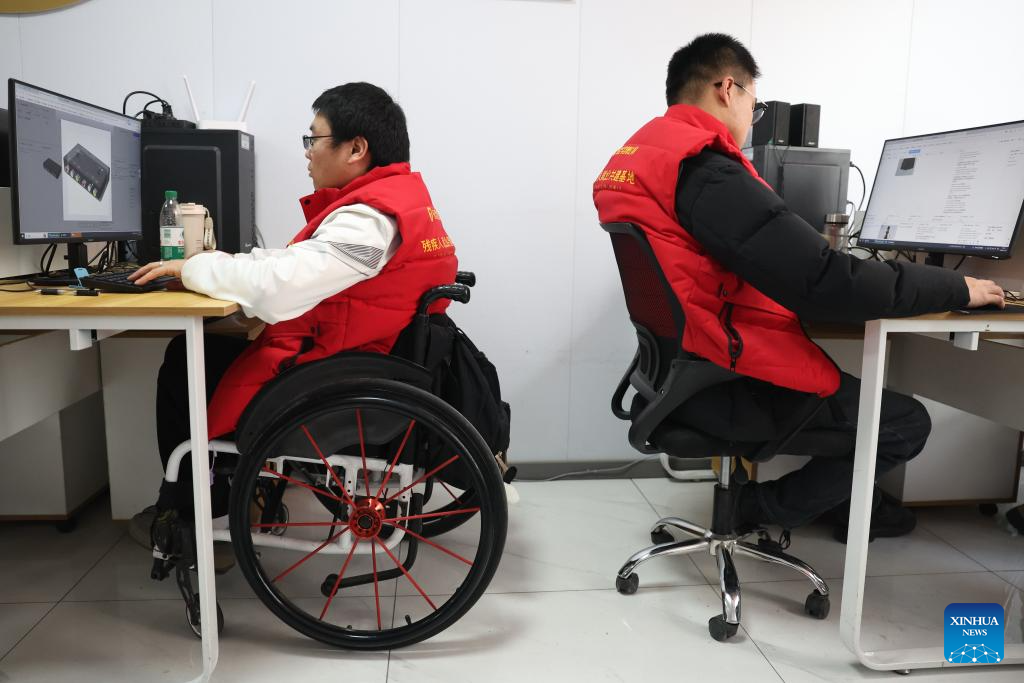
AI training engineer Li Weiming (L) performs data annotation at a workshop for people with physical disabilities in Lanzhou, northwest China's Gansu Province, Jan. 14, 2026.(Xinhua/Chen Bin)
LANZHOU, Feb. 6 (Xinhua) -- At first glance, this room looks no different from any other white collar office in a high-rise building, with employees busy at their computer screens, accompanied by a steady rhythm of clicks and taps.
Working as data annotators, most of the staff at the Xinlianxin social work services center in Lanzhou, the capital of northwest China's Gansu Province, have physical disabilities. They serve as "teachers" for AI computer models, providing essential human guidance to improve the accuracy and reliability of artificial intelligence.
Data annotation is a fundamental part of the AI chain. By tagging various types of data as text, audio, images or videos, for example, the process gradually teaches AI models. Those engaged in such labeling work are often referred to as data annotators. Their tasks range from labeling pedestrians and vehicles in street view images to marking the pronunciation and meaning of speeches, or identifying the semantics and expressive nuances of texts.
In 2020, "data annotator" was included in China's occupational classification catalog. It has become an employment option for people with physical disabilities due to its low physical demand and capacity for remote work.
People with disabilities often possess unique advantages in data labeling work. For example, those with hearing impairments may have higher levels of visual perception, enabling them to detect subtle differences in image annotation tasks quickly, and people with mobility constraints often display greater stability in their hand movements, making them well-suited to prolonged keyboard and mouse operations.
In the past, many people with disabilities relied on handicraft work to make a living, said Wang Lihong, head of the Gansu provincial services center for vocational education and the employment of people with disabilities. "Last year, after learning of this emerging profession, we launched a training program for data annotators, and about 19 trainees have obtained vocational skill certificates to date."
Yang Zhiwen, 33, was one such trainee. He sustained a permanent injury to his right leg in a car accident during childhood. He is now employed by a Beijing-headquartered high-tech company and commutes regularly to the center in Lanzhou.
"I am interested in AI. When I heard about this training from community workers, I signed up immediately," Yang told Xinhua, after reviewing an AI-generated sale description of a woven handbag on a major domestic e-commerce platform.
For Yang, text annotation is the easiest work. He also deals with images, audio and 3D content. "I can sit still and stay patient," Yang said. "If I do not get it right the first time, I will try again until I nail it."
"It gives me a real sense of achievement," he said, adding that the job enables him to keep pace with the times, rather than being left behind.
Like Yang, most other employees at the center have severe physical disabilities, which are their greatest barrier to employment. But the data annotator profession enables them to make use of strengths in focus and patience. According to the center, graduate trainees have found jobs in sectors such as automotive, catering, film and information services.
Xu Junlin, 28, had long been unemployed and remained at home, describing herself as "introverted." Her new job in AI enables her to earn 3,000 to 4,000 yuan (about 431 to 575 U.S. dollars) per month and gives her confidence in her life.
"It feels fulfilling," she said.
Similar training programs have been launched across China.
As AI technology evolves, data annotation is also undergoing an accelerated transformation.
About 60 to 70 percent of simple or repetitive labeling tasks can now be done by AI models. "Human efforts are needed in emerging, complex and niche sectors," said Liu Ji, a technical director at Jingshuyun big data technology company in Shenyang, the capital of northeast China's Liaoning Province. More than half of the employees in the company are people with disabilities.
Liu said the data labeling industry is shifting from being labor-intensive to being tech-intensive, requiring more from data annotators in terms of accuracy, efficiency and comprehension.
Many local governments have cooperated with enterprises and universities, offering job opportunities and guidance for people with disabilities to participate in data annotation work through learning and practical applications.
"The times have given us these opportunities, and we must keep pace and upgrade our skills," said Wang Xiao, who works in Shanghai. Formerly a massage therapist, she has completed relevant training and become a data annotator specializing in the transportation sector.
Her opinion was echoed by Yang in Lanzhou. "I used to think obtaining a basic vocational skill certificate was enough, but I have changed my mind and aim to earn intermediate and advanced certificates to work for a bigger platform." ■


