Yearender: Accelerated scientific infrastructure in China delivers promising results

BEIJING, Dec. 22 (Xinhua) -- China has seen rapid progress in major scientific and technological infrastructure over the past five years, with many large-scale facilities completed and key technologies achieving breakthroughs.
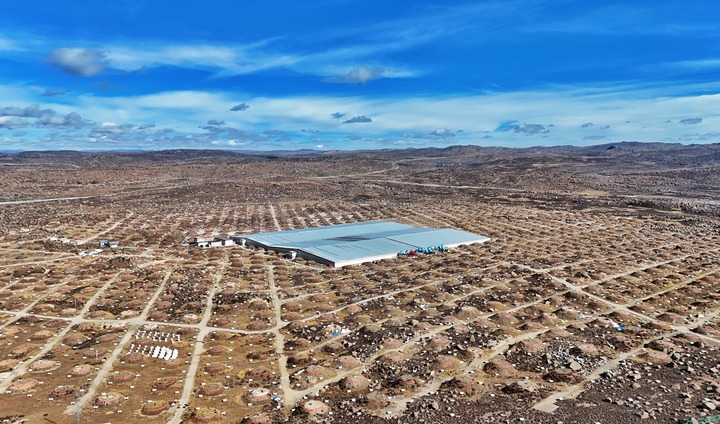
Last month, the Large High Altitude Air Shower Observatory (LHAASO) announced a major discovery after capturing crucial observational evidence suggesting that black holes may play a key role in producing high-energy cosmic rays in the Milky Way.
This is only one of the impressive results that the gigantic instrument, which spreads across 1.36 square km on Haizi Mountain in Daocheng in southwest China's Sichuan Province, has achieved in recent years.
In 2022, it captured the brightest gamma-ray burst ever recorded in history, and in 2023, it released the precise high-energy gamma-ray spectrum of this brightest gamma-ray burst.
The formidable instrument and its discoveries exemplify China's unswerving commitment to pushing the boundaries of human knowledge.
MAJOR PROJECTS BEAR FRUITS
To date, more than 65 large-scale scientific facilities have been completed or are under construction across the country. Operational facilities are steadily yielding new breakthroughs, while next-generation projects are already in development.
In November, the Jiangmen Underground Neutrino Observatory (JUNO) in south China's Guangdong Province, the world's largest transparent spherical neutrino detector, reported its first major achievement, marking a significant milestone in its decade-long construction.
Using 59 days of effective data after the start of operation on Aug. 26 this year, JUNO has already measured two of the solar neutrino oscillation parameters with a factor of 1.5 to 1.8 better precision than previous experiments.
Approved in 2013, JUNO commenced underground construction in 2015 and began data collection in August this year.
China also achieved the world's first thorium-to-uranium nuclear fuel conversion in a Thorium Molten Salt Reactor (TMSR) in northwest Gansu Province. Having reached full power in June 2024, it is currently the world's only operational molten-salt reactor loaded with thorium fuel.
In October, the National Astronomical Observatories announced that China's Five-hundred-meter Aperture Spherical Radio Telescope (FAST), also dubbed the "China Sky Eye," has identified more than 1,152 new pulsars -- far exceeding the total discoveries by all other international telescopes combined.
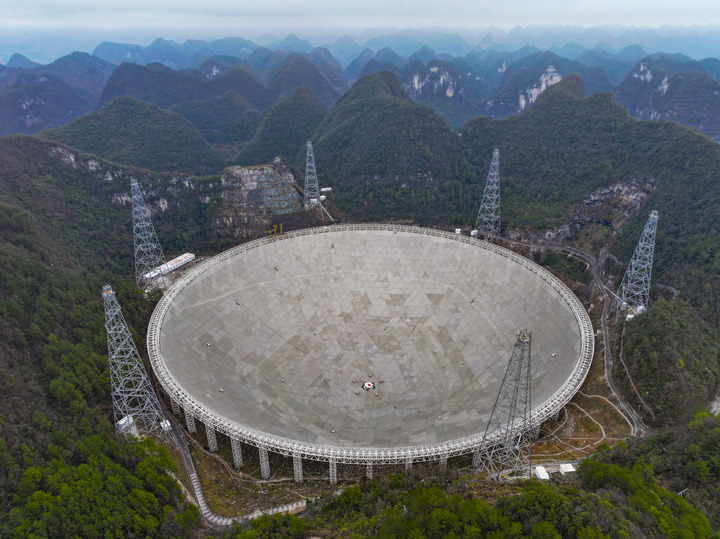
As the world's largest and most sensitive single-aperture spherical radio telescope, FAST has achieved a series of major breakthroughs during the 14th Five-Year Plan period, cementing China's position as a global leader in radio astronomy.
In September, China launched the world's largest centrifuge by capacity, which can generate 300 times Earth's gravity and accommodate loads of up to 20 tonnes.
The machine, coded CHIEF1300, is one of the core components of the Centrifugal Hypergravity and Interdisciplinary Experiment Facility (CHIEF) currently under construction in Hangzhou, east China's Zhejiang Province.
In May, China officially commenced the overall assembly of the Burning Plasma Experimental Superconducting Tokamak (BEST) project in Anhui Province.
Dubbed the "artificial sun," the BEST facility is scheduled for completion by the end of 2027. It represents one of China's major ventures into controlled nuclear fusion and is poised to attempt the world's first fusion energy power generation demonstration.
INNOVATION SHAPES FUTURE
Over the past five years, China has consistently placed innovation at the core of its modernization drive, continuously advancing its technological infrastructure and platform development.
During the 14th Five-Year Plan period, China's R&D spending repeatedly reached new highs, with investment in basic research hitting 249.7 billion yuan (35.47 billion U.S. dollars), an increase of over 70 percent compared to 2020.
The push for greater self-reliance and strength in science and technology has accelerated, driving the construction of major national scientific and technological infrastructure into a phase of rapid expansion.
Large-scale scientific facility clusters have taken shape in Beijing, Shanghai and the Guangdong-Hong Kong-Macao Greater Bay Area, serving as wellsprings of original innovation that drive high-quality development.
The development of China's major scientific facilities is creating new platforms for expanded international cooperation to address pressing global challenges.
In recent years, China has opened many of its large-scale research infrastructures to the global research community.
The landmark project JUNO already involves over 300 scientists from 16 countries and regions. Since March 2021, FAST has approved 27 applications from researchers in 14 countries. Building on this momentum, China has launched an international science program on fusion burning plasma research, opening several key fusion platforms for global collaboration.
As highlighted by Wang Di, Chinese ambassador to Canada, these facilities provide crucial research platforms to tackle shared issues such as climate change, public health and energy crises, demonstrating China's commitment to a shared future for humanity.
"China will continue to expand the international access and cooperation of its major scientific facilities and welcomes international scientists to participate in building and sharing these platforms," he said. ■









Comments