Feature: A softer pour: Inside the rise of China's domestic whiskies

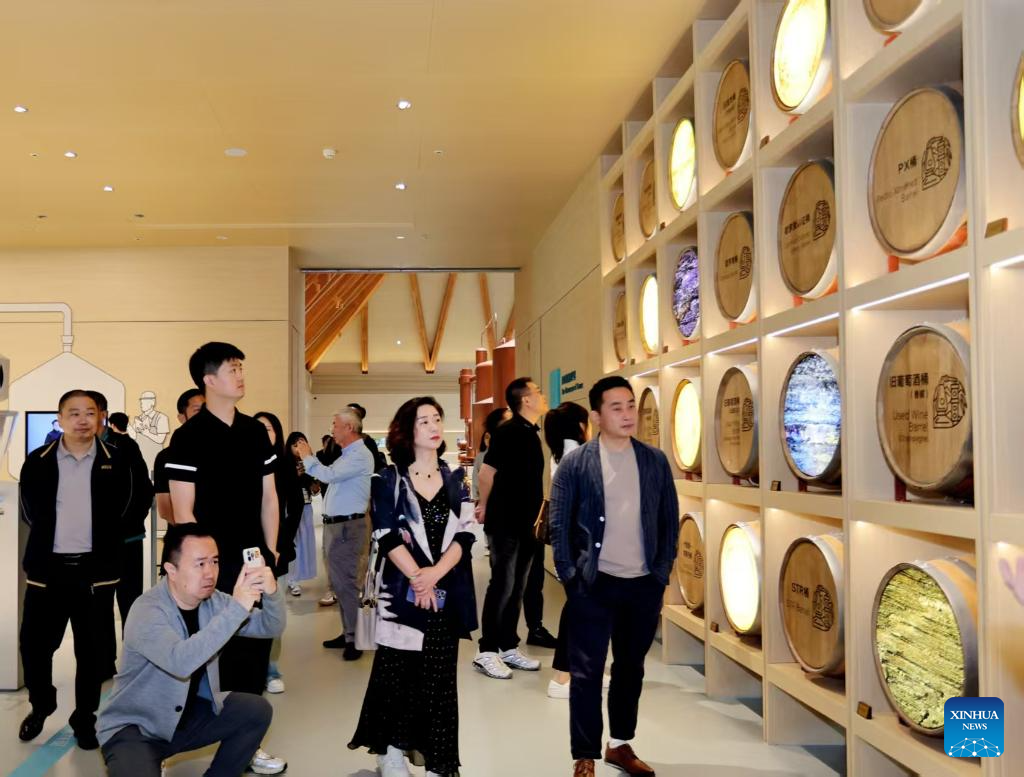
People visit the experience center upon its opening at Laizhou Distillery in Qionglai City, Chengdu, southwest China's Sichuan Province, April 29, 2025. (Xinhua)
CHENGDU, Dec. 17 (Xinhua) -- For a long time, alcohol in China has primarily served as a social lubricant, a tool for banquets, business dealings, and collective gatherings, where formality, etiquette, and drinking prowess took center stage.
In recent years, however, that logic has begun to loosen, not through dramatic disruption, but through a series of quiet, cumulative changes.
One of the clearest signals is the rising popularity of the Whisky Highball. In bars around Jiaozi Avenue in Chengdu, southwest China's Sichuan Province, the simple mix of whisky, ice and soda water, deliberately mellow in strength and slower in pace, has become the most frequently ordered drink. The bartender put it plainly: on a busy night, he would make more than 60 Highballs.
The appeal lies not in novelty but in fit. Born in dense, fast-paced Asian cities, the soda-cut drink sustains presence and poise after hours, suited to a culture that favors moderation over excess. Its rising popularity signals a quiet shift in when, why and how people drink.
Industry figures suggest this is more than a niche urban curiosity. According to the China Alcoholic Drinks Association (CADA), the country's whisky market grew more than fourfold between 2013 and 2023, noticeably broadening its consumer base. In commercial districts across major cities like Chengdu, the steady opening of new bars over the past five years tells a parallel story, one marked not just by growing numbers but by a visibly younger clientele.
More importantly, whisky is no longer consumed only in formal or aspirational contexts. It has entered relaxed bars after work, intimate gatherings, even late-night convenience stores, not as a display of drinking prowess, but as a means to unwind. This stands in stark contrast to the long-dominant banquet culture, where high-proof baijiu once ruled.
He Yong, secretary general of CADA, sees the shift as structural rather than stylistic. He noted that changes in drinking habits are closely tied to more profound transformations in social structure, generational values and economic development. Younger consumers, he said, are making more individualized choices, prioritizing emotional ease and atmosphere over convention. In this light, drinking is becoming less a social obligation and more a matter of personal alignment.
Market indicators reinforce this reading. Over the past two years, China's whisky imports have declined in both volume and value, while domestic production has continued to expand and diversify. Consumers are increasingly guided not by country of origin or brand prestige, but by flavor, experience and value, voting with their palate rather than their status.
As He put it, how one drinks has become a form of self-expression, a marker of taste and lifestyle. The move from "pleasing others" to "pleasing oneself," he said, is a natural evolution in a maturing consumer market.
The shift in demand has rapidly reshaped the supply side. In 2023, China's domestic whisky output reached 50,000 kiloliters, a year-on-year increase of 127 percent. For Luo Long, manufacturing center general manager at Laizhou Distillery, the country's largest domestic whisky producer in Sichuan's Qionglai City, such growth reflects accumulated momentum rather than sudden enthusiasm.
Luo's team has navigated both expansion and volatility in recent years, while helping shape local production standards and supply chains. In his view, the real challenge for Chinese whisky is market breadth rather than technical capability. To grow beyond a niche, producers must win over consumers across regions with sharply different habits and expectations.
Market research across provinces reveals the complexity: China has no single whisky palate. Consumers in Fujian lean toward lighter, fruit-forward notes, while in Guangdong, pairing with food carries more weight. Inland regions entered the market later but are now growing faster. Younger drinkers show keen interest in innovative mixed drinks, and online creators have turned "convenience-store cocktails" into a distinct lifestyle statement.
Consequently, domestic producers like Laizhou have steered clear of merely following the imported whisky playbook, which often relies on premium positioning and exclusive urban circles. Instead, they have drawn on long-established practices from China's baijiu industry: expanding into lower-tier markets, strengthening distributor networks, diversifying drinking occasions and investing in steady, long-term consumer education.
At the same time, the focus is shifting toward building a distinctly local flavor profile. Historically, Chinese whisky makers were heavily dependent on imported casks and raw materials, elements decisive to taste. Yet according to Luo, that reliance is now loosening. With domestic supply chains maturing, highland barley, wheat and corn are entering the distillation process, expanding experimentation toward defining a flavor identity of its own.
One notable innovation is the use of yellow wine casks for maturation. As the spirit ages, the fermented sweetness and aromatic compounds from the traditional wine seep into the whisky, a profile some in the industry dubbed "Oriental Sherry." The resulting flavor aligns naturally with Chinese cuisine while carving out a distinct place within the global whisky landscape.
Geography adds another layer of differentiation. In the humid, hilly terrain surrounding the Sichuan Basin, the climate shapes maturation in ways distillers say are hard to replicate.
At the foot of Mount Emei, a UNESCO World Heritage Site, Yang Tao, chief distiller at THE CHUAN Malt Whisky Distillery, built by French spirits giant Pernod Ricard, noted that what some call a uniquely "Eastern woody character" is less a designed concept than an organic emergence.
Notes reminiscent of sandalwood or nanmu wood often evoke the scents of local temples and stone-paved paths, he said. It is an imprint of place, not intention, slowly forming a terroir-specific vocabulary.
"We're exploring what doesn't yet exist in the world of whisky," Yang said. To him, localization is not about imitating established traditions like those of Scotland or Japan, but about extending naturally from local culture, resources and flavor sensibilities. As domestic raw materials and cask techniques evolve, a profile "as gentle and smooth as jade" is steadily taking shape.
Over the past five years, China's whisky industry has accelerated its localization. International spirits groups have ramped up local production, major domestic baijiu producers have stepped into the category, and large beer makers, attracted by shared production processes, have crossed into whisky too, joined by steady flows of domestic capital.
These converging forces have driven rapid scaling. Industry estimates put China's whisky bottling volume at around 80,000 tonnes last year, several times higher than when the market relied primarily on imports.
Reports also showed that in 2025, the market has continued to trend toward younger, more female, more inward-focused and more geographically dispersed consumers, with increasingly rational decision-making. In this context, domestic whisky is expected to move from being a substitute to a driver of growth.
Figures show China's whisky market reached about 5.5 billion yuan (about 779 million U.S. dollars) in 2024, up 12 percent year-on-year. While still modest compared to the vast baijiu sector, its momentum and experimentation are drawing global attention. At the International Wine & Spirit Competition's annual Awards Celebration held in London last month, products from Qionglai earned 47 awards, spotlighting not only baijiu but Chinese whisky and other emerging categories.
Industry observers see two likely paths for overseas growth: building credibility through international competitions and opening markets with competitive pricing and process innovation.
Back in Chengdu, Jiaozi Avenue remained brightly lit late into the night. "What people drink isn't that important," the bartender said. "What matters is that they desire a moment of relief and ease." ■


