




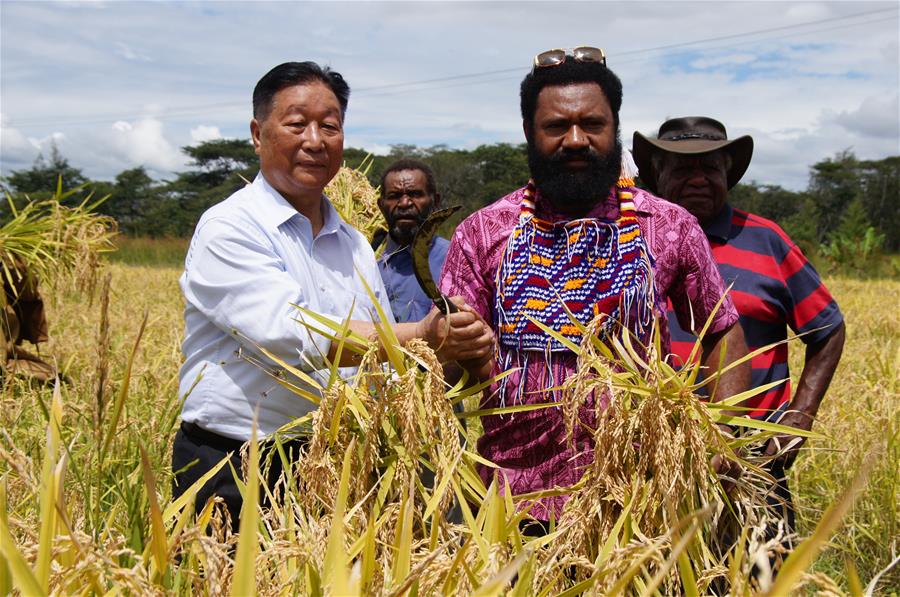
File photo taken on April 25, 2018 shows Lin Zhanxi (front L), professor with the Fujian Agriculture and Forestry University (FAFU), poses for photos with local famers as they celebrate rice harvest in Papua New Guinea. (Xinhua)
by Xinhua writers Fang Ning, Gu Qianjiang, He Fei
PORT MORESBY/FUZHOU, Nov. 16 (Xinhua) -- Small is the new big. A group of wild grass is China's contribution to the world's sustainable development, and its multiple uses are shared with 105 countries to help tackle food issues and desertification.
China on Friday signed an aid project with Papua New Guinea using the grass technology, one day ahead of the Asia-Pacific Economic Cooperation (APEC) Leaders' Meeting scheduled to be held in the Pacific island country. It is also China's 12th international aid program in poverty relief using the grass.
Known in China as Juncao (meaning "the herbal plant for growing edible mushrooms"), the grass has worked miracles for Chinese scientists who are cultivating it as a substrate for growing edible and medicinal mushroom or forage for livestock, as well as using it as green barrier to stop sand dunes from moving.
The grass is not new to Papua New Guinea. China introduced the grass and its cultivation technology to the country over 20 years ago to help local farmers raise livestock and grow edible mushrooms.
In 2017, the yield of the grass in Papua New Guinea set a world record of 854 tonnes per hectare. The grass grows up to 8 meters tall and is harvested three to six times a year. It contains 11 percent to 17 percent crude protein. The per-hectare harvest of the grass can feed 400-500 sheep or grow 100 tonnes of fresh fungi.
"We hope the newly inked agreement will help double the agricultural production capacity and farmers' incomes in the Eastern Highlands Province of Papua New Guinea," said Lin Zhanxi, a 76-year-old professor with the Fujian Agriculture and Forestry University (FAFU) and the chief scientist for grass development.
The aid program is expected to help lift 30,000 people out of poverty in the province by 2023.
Thirty-two years ago, Lin selected the grass species to replace timber as a substrate for growing fungi, a local cash cow, in east China's Fujian Province, and this has saved a vast coverage of natural forest there.
Through the years, Lin has developed 45 varieties of Juncao, which can be used to cultivate 55 mushroom species.
The agricultural technology has been widely promoted at home through China's poverty alleviate projects in western areas including Xinjiang Uygur, Tibet and Ningxia Hui autonomous regions since 1991.
The grass was also planted to fight desertification. On the banks of the Yellow River, China's second-longest river, a mass planting of Juncao grass has been underway, aiming to build a 1,000-km long green barrier by 2021 to treat the heavily eroded land and protect it from sand invasion. The project, initiated by Lin and several Chinese academicians, was sponsored by the Chinese Ministry of Water Resources.
The Juncao technology won the Geneva State Prize at the 20th International Invention Exhibition in 1992 and the Prize of French Ministry of Interior and Land Planning in the 85th Paris International Invention Exhibition.
In 1994, the technology was listed by the United Nations Development Programme (UNDP) as one of China's Priority Projects for Cooperation with Other Developing Countries.
Since 1992, China has shared the technology with 105 countries by opening training classes and conducting on-site demonstrations.
FAFU alone has provided training to some 7,000 foreigners. Among them, 15 students from eight countries have obtained the university's graduate and doctorate degrees in the research of Juncao technology.
Despite his age, Lin has often traveled afar to help people in developing countries learn about the benefits of this agricultural technology.
"The first time I went to Papua New Guinea in 1997, I realized how people there were struggling with the extreme poverty," said Lin.
At that time, a tribe chief knelt down before Lin to thank him for bringing the technique to save them from starvation. To his astonishment, the tribe people made an all-night long revelry.
Members of the team were so touched that they decided to stay and help the people shake off poverty. In a land without electricity or modern devices, the team members worked there for eight years to teach locals how to cultivate and use the grass.
Lin's daughter Lin Dongmei, also his assistant, has been overseeing the Juncao technology overseas projects.
"Every time I arrive in a new place to share Juncao tech, I study the local government's policies and collaborate with them for optimizing the agricultural planning," she said.
In Africa, many countries do not have the tradition of eating mushrooms. Lin's team shows them how to cook with mushrooms.
With the team's incessant efforts, the Sino-Lesotho Juncao Technology Demonstration Base has been built in the capital city of Maseru, Lesotho, covering an area of 10,000 square meters with around 4,000 square meters of fields of Juncao grass.
The base has trained more than 2,500 local officials, farmers, teachers and students.
Local farmers started harvesting mushroom 7 to 10 days after planting. Managing a 10-square-meter mushroom trench, a household can harvest 1,200 kg of fresh mushrooms per year and earn 40,000 Maloti (about 2,840 U.S. dollars) -- three times the annual income of a local worker.
"Since I started planting mushrooms, my life has changed," said Kekeletso Seoehla. "I was able to get nice furniture and give my child a better life and education."
Growing the grass has evolved into a bio-agriculture that involves growing mushrooms, raising livestock, water and soil conservation, livestock feed processing, food processing and biomass energy generation.
Richard Yankey from Ghana is a doctoral student in microbiology at FAFU. Yankey said he believes the Juncao grass is a possible solution to treat environmental problems in Ghana, from barren soil to pollution resulted from mining.
The former university teacher said he would teach more students in Ghana how to use Juncao for desertification control and mushroom planting.
Lawandi Ibrahim Datti from Nigeria attended an international training course on the Juncao technology in Fuzhou eight years ago, and now he is back.
He has initiated the establishment of the Juncao Technology Demonstration Center in Nigeria. "I have gone so far in transferring the technology and the knowledge to my country, in an effort not only to improve the life of farmers and women and the environment, but also to alleviate poverty and promote productive employment," Datti said.
Enrolled in the Ph.D. program on Juncao technology at FAFU, Datti also suggested to his wife that she should also complete the same master's program he had.
(Xinhua reporters Bai Xu and Mi Yingting contributed to the story.)
(Video reporters: Mi Yingting, Chen Wang, Wang Chao, He Fei; Video editor: Zhang Xinyi)
