




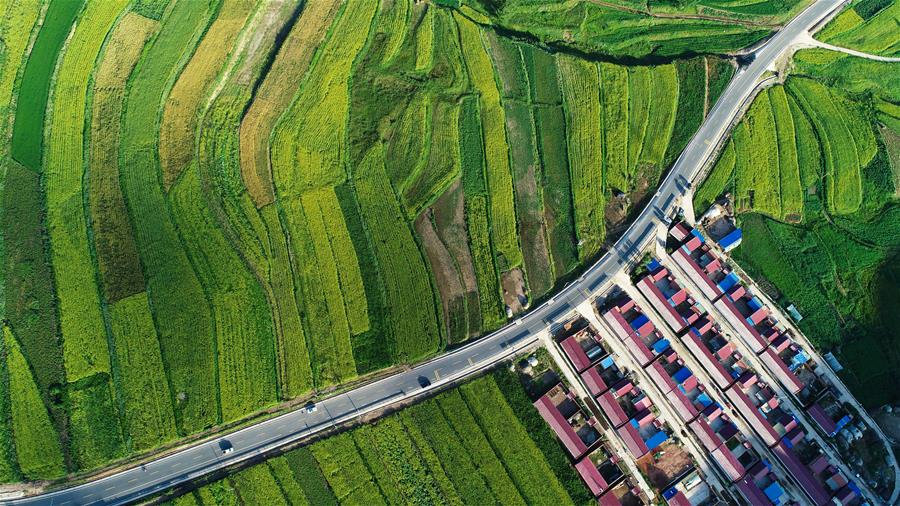
Photo taken on Aug. 19, 2018 shows a newly-built road across rapeseed flower fields in Guyuan, Xihaigu, northwest China's Ningxia Hui Autonomous Region. (Xinhua/Wang Peng)
YINCHUAN, Sept. 24 (Xinhua) -- Huang Zhanding, 74, a resident of Shanghuang Village, sometimes stares at his old cave dwelling less than a kilometer away from his new home.
Huang lived in the cave for more than 60 years, but moved to a brick home in 2007. He currently lives in a bigger home, with modern home appliances, completely different from life in the cave.
Shanghuang, administered by the city of Guyuan, northwest China's Ningxia Hui Autonomous Region, is in Xihaigu, a largely mountainous region which used to be labeled the "most unfit place for human settlement" by the United Nations in the 1970s due to land reclamation, drought and a fragile ecological environment.
Xihaigui comprises nine impoverished counties and districts, which fall under jurisdiction of three cities of Guyuan, Zhongwei and Wuzhong in southern Ningxia. Nearly 200,000 residents in Xihaigu live below the poverty line, accounting for around 80 percent of Ningxia's population in poverty.
Data showed rural residents' income in Xihaigu was only 40 percent of the national average in 1982. And more than 846,000 people of the region lived on government relief.
Over the past decades, however, Xihaigu has witnessed enormous changes as the country has been waging war on poverty.
"Life is much better now. There is tap water, rice, noodles, vegetables and meat. I can eat whatever I want," Huang said.
BITTER MEMORIES OF WATER
When Huang looks at the old cave, bitter memories come flooding back. People used to have to get up before dawn to carry water from the local streams. Those who came to the streams too late did not have water to drink.
"We could only get water from a small stream in the ravine each day. Cattle and sheep drank water there. It tasted terrible, but we had no choice," Huang said.
Ma Hanwen also lives in Xihaigu. He used to collect spring water in the mountains with his donkey, and stored rainwater in a cistern. When that was used up, he had to buy water 15 km away. Water was incredibly sparse.
"I read from textbooks that water from lakes and rivers ran into the ocean. It was beyond my imagination that how much water there could be," Ma said.
Fortunately, cisterns, water buckets, and donkeys have become memories, as a safe drinking water project started supplying water to residents in central and southern Ningxia in 2016.
With an investment of 4 billion yuan (about 590 million U.S. dollars), 1.1 million residents in the regions now have access to safe drinking water. Nearly 95 percent of rural households in Guyuan have tap water.
"Only through solving the problem of water shortages can poverty be reduced," said Bai Yaohua, head of the regional water resources department.
Xihaigu has been channeling water from the Yellow River and Jinghe River, a tributary, and developing water-saving approaches.
In Guyuan, about 1,100 cubic meters of fresh water will be diverted annually from the Yellow River, which enables the city to begin growing vegetables and herbs, and developing a wine industry.
ROADS TOWARD WELLBEING
Rural residents in mountainous Xihaigu in the past could rarely travel far due to a poor transport infrastructure, which adversely affected employment, education and healthcare.
"When I was in primary school, many pupils in villages had to get up at 4 a.m. and travel 3 km or 4 km to get to the school. When it snowed, roads on the mountains would be blocked. I would not see my classmates for many days," recalled Ma Hanwen, the resident from Xihaigu.
The primary school in Ma's village only provided education for lower grade students. Those who wanted higher education had to go to schools in township seats much further away.
"The dropout rate was extremely high, especially for girls. Their parents preferred them to stay at home and do farm work," Ma said.
In 2004, Wu Wenxue started to develop a celery farm in Xiji, one of the most impoverished counties in Xihaigu. The poor transportation network bothered him.
"Paths in the fields were very bumpy. Trucks couldn't reach the fields, so people carted celery from the fields to load into trucks," Wu recalled. "It was not only the village paths that were bad, but road conditions linking the villages and county seats were also very poor."
"It would take more than two hours to pass through a section of 20-km-long bumpy road in the mountain. Drivers were not willing to come to Xiji."
In December 2016, a 46.5-km expressway linking Xiji and Guyuan opened. Trucks loaded with Wu's celery have been shuttled from Xiji and neighboring provinces and regions ever since.
"Freshness is money. Upgraded roads save time and create more profit for me," Wu said.
Guyuan has invested 21 billion yuan to build and renovate roads over the past five years, with all township seats and villages now having good roads.
GREEN INDUSTRIES
To uproot poverty, the government support is not enough.
"The key to leading people to escape from poverty is to stimulate their initiative," said Wang Shuling, deputy director of the poverty relief office of Guyuan.
With water shortages and poor transport solved, water-saving irrigation systems, enterprises from other provinces, and new industries have been introduced to Xihaigu.
Wang Rong used to grow corn and potatoes in Suanci Village, relying on the weather, and was initially not confident about the adjustment of agricultural produce by the local government.
He began to plant Mexican marigolds last year, but had many doubts. "It was hard for me to grow flowers rather than crops. I did not know flowers could make money."
But the choice of marigolds, which contain lutein, widely used in food and medicine, was carefully selected by the local government. The output of marigolds is one-third higher than ordinary crops.
"We encouraged residents to grow marigolds and provided them subsidies and training, and brought orders from enterprises. They don't need to worry about the management and sale," said Ma Xiong, deputy Party secretary of Jiqiang Township, which administers Suanci Village.
When the flowers were harvested, Wang's worries had gone. "I can earn about 30,000 yuan for each hectare of marigolds."
Marigolds were introduced to Guyuan since 2014, and 22 townships in the city have now planted more than 2,333 hectares of Marigolds.
Ma Xiong said he plans to lead villagers to develop rural tourism, attracting urban residents to the stunning views of the Marigold fields.
Besides marigolds, Guyuan has established 38 pilot zones to cultivate more than 250 species including trees, flowers and grass, which fit the weather and local terrain. Poverty is on the wane.
There were more than 501,000 people living below the poverty line in Guyuan in 2011. That figure dropped to 95,500 in 2017. By 2020 the number should be zero.
Over the past 35 years, Ningxia has resettled many residents as it has improved the region's environment. Xihaigu alone has seen more than 1.3 million residents relocated. Residents who left their farms have been provided with good jobs.
Ma Hanwen was among the migrants, but returns to his old hometown every year with his children.
"I returned to visit the tombs of my ancestors and discovered the ecology and environment that had been damaged by human actions were being restored," said Ma.
(Video editor: Zhao Yuchao)
