




 ?
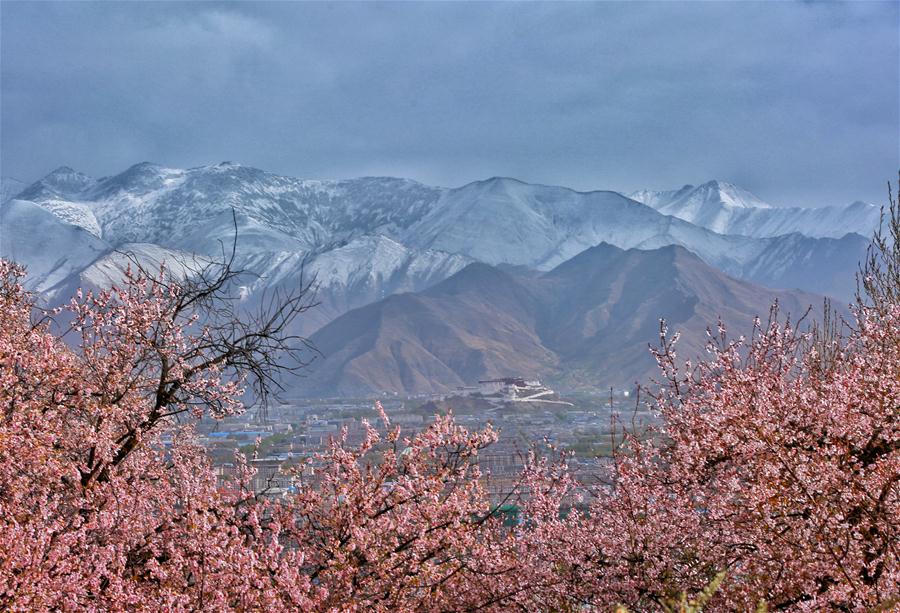
?Photo taken on March 29, 2018 shows flowers blooming in Lhasa, capital of southwest China's Tibet Autonomous Region. (Xinhua/Yexe Dainzin)
BEIJING, July 18 (Xinhua) -- The Qinghai-Tibet Plateau, which covers over one-fourth of China's land area, is still one of the cleanest regions on earth, said a white paper issued by the Chinese government Wednesday.
With a low intensity of human activity on the Plateau, "the air quality is little impacted, the types of pollutants are few and the density is low, and the content of pollutants is similar to those at the North Pole," said the white paper, titled "Ecological Progress on the Qinghai-Tibet Plateau."
Ecological progress on the Plateau in the new era is an essential component of the Beautiful China initiative, which aims to create good working and living environments for Chinese people and play China's part in ensuring global ecological security.
The Communist Party of China and the Chinese government have made ecological conservation a top priority, and believe protecting the Plateau is a vital task for China's survival and development.
A conservation and protection system is being developed step by step for the Plateau, with solid achievements in improving ecological conservation and environment quality, according to the white paper.
The local green industry has witnessed steady growth with a system of technological support in place, and an eco-culture is taking shape to showcase the Plateau's exemplary role in ecological development, it added.
Located in southwest China, the Qinghai-Tibet Plateau covers the entire Tibet Autonomous Region and Qinghai Province, in addition to parts of Sichuan, Yunnan, Gansu, and Xinjiang.
It is about 2.6 million square kilometers in area, and most of it lies at an altitude of more than 4,000 meters above sea level.
Hailed as the "roof of the world," the "third pole" and the "water tower of Asia," the Plateau is a natural habitat for rare animals and a gene pool of plateau life. It is a key eco-safety barrier in China and Asia, and a focus of the country's drive to promote ecological progress.
ECOSYSTEM CONSERVATION
China has established an ecological compensation mechanism for the Plateau.
From 2008 to 2017, the central government made transfer payments of 16.29 billion yuan (2.44 billion U.S. dollars) and 8.35 billion yuan to key ecological function zones in Qinghai and Tibet, respectively, covering 77 key counties and all areas prohibited to development by the state, according to the white paper.
China is improving its policies and regulations for the Qinghai-Tibet Plateau to form an increasingly complete system for ensuring ecological progress.
A system of protected natural areas has been set up in the region, it said.
To date, the Plateau has established 155 nature reserves at all levels (41 state and 64 provincial ones), covering a total area of 822,400 square km. This is equivalent to 31.63 percent of the Plateau's landmass and represents 57.56 percent of China's land nature reserve areas.
A number of eco-projects have been implemented on the Plateau, achieving positive results in ecosystem conservation, reining in the degradation of the local ecosystem and restoring biodiversity, said the white paper.
The restoration and expansion of rare and endangered species is visible evidence of success in biodiversity conservation, it added.
The number of Tibetan antelope on the Qiangtang Plateau in Tibet Autonomous Region increased from about 60,000 in 2000 to over 200,000 in 2016. The number of wild yak in this area increased from 6,000 before it was included for protection, to 10,000 in 2016.
The Chinese government has carried out a number of projects for overall improvement of river basins, improvement of urban and rural living conditions, and prevention and control of pollution from factories and mines, according to the white paper.
Zhang Yongze, vice chairman of Tibet Autonomous Region, said at a press briefing that more than 94 percent of the region's rivers are prohibited from exploitation and development.
"Tibet remains one of the areas in the world with best environmental quality," Zhang said, noting that most areas of the region are in a primordial state.
Tian Jinchen, vice governor of Qinghai, told the same briefing that the province had witnessed an increase in its green coverage, water resources, area of wetland ecosystem, biodiversity and herdsmen's income over the years, while its desert has been dwindling.
The area of Qinghai Lake, China's largest saltwater lake, has expanded more than 170 square kilometers since 2005, reaching a record size in 40 years. Nearly 1,000 highland lakes and wetlands, which disappeared in the late 1990s re-emerged in the Sanjiangyuan area, according to Tian.
"The concept of ecological protection is on the mind of every herdsman," said Drolmayap, a herdsman-turned park ranger for the Sanjiangyuan National Park, which started trial operation in 2016, to protect the headwaters of the Yangtze, Yellow and Lancang (Mekong) rivers.
Sanjiangyuan means "the source of three rivers." The environment had degraded due to human activity such as overgrazing but has seen improvement over the past decade with intensified conservation and restoration input.
"The area has come back to life with blue sky, green grass, and clear water," Drolmayap said. "We frequently see Tibetan antelopes, which used to be a rare occurrence."
GREEN DEVELOPMENT
An economic model featuring a circular economy, renewable energy, and distinctive industries is forming on the Plateau, signaling an increasing level of green development.
The white paper pointed out that the unique strengths of local agriculture and animal husbandry have become increasingly outstanding on the Plateau.
Since 2004, China has invested more than 3 billion yuan in Tibet, directed to more than 450 projects in 10 categories related to agriculture and animal husbandry unique to the region, such as highland barley, yak-breeding, and traditional Tibetan medicine.
More than 100 leading enterprises have emerged as a result, increasing the incomes of local farmers and herdsmen by 1.18 billion yuan and benefiting 1.75 million people.
Tourism has become an important channel for green growth and higher incomes for farmers and herdsmen.
In 2017, Tibet hosted more than 25.61 million visitors, and its revenues totaled 37.94 billion yuan, representing 28.95 percent of the region's GDP; Qinghai received 34.84 million visitors, and its revenues totaled 38.15 billion yuan, representing 14.44 percent of the province's GDP, according to the white paper.
Green energy also developed rapidly on the Plateau which is rich in hydropower, solar energy, geothermal energy, and other green energies, said the white paper.
To monitor eco-environmental changes on the Plateau, China has set up a complete monitoring and early-warning system that integrates air and land networks.
The Qinghai-Tibet Railway is a landmark project, demonstrating the guidance given by sci-tech innovation to green development.
As the Intergovernmental Panel on Climate Change stated in its fourth and fifth assessment reports, the railway offers a successful example in building "green" railways adapted to climate change. Science magazine in the United States published an article on April 27, 2007, describing the railway as "an ecological miracle."
The white paper, however, noted that the Plateau still faces many ecological challenges, including glacier retreat, melting permafrost, and other growing disaster risks due to global warming, and prominent contradictions between protection and development in the course of economic growth.
In the future, China will continue to consolidate and further its ecological achievements on the Plateau, including reforming its environmental monitoring system and refining the low-carbon and circular economy and safe and efficient energy system.
"Tibet is open to international cooperation," said Zhang Yongze. "We welcome countries with advanced technologies to participate in the ecological environment protection of Tibet."
